Rejection Recovery
If your application is rejected again, we refund every rupee - no questions asked.
Government Fee
₹2,690
Mandatory fee set by Latvia
Atlys Fee
₹8,832
Approval Guarantee Fee (incl. 18% GST)
Total Amount
₹11,522
Atlys Protect
If your application is rejected again, we refund every rupee
Talk to an expert
Not sure if you should reapply? Get a free reapplication strategy.
 Data sourced from over 24,000+ Atlys applications
Consulate Specific Data
We’ve identified consulate-specific patterns across India based on which profiles get approved or rejected. This helps pinpoint exactly where your application needs to be stronger.
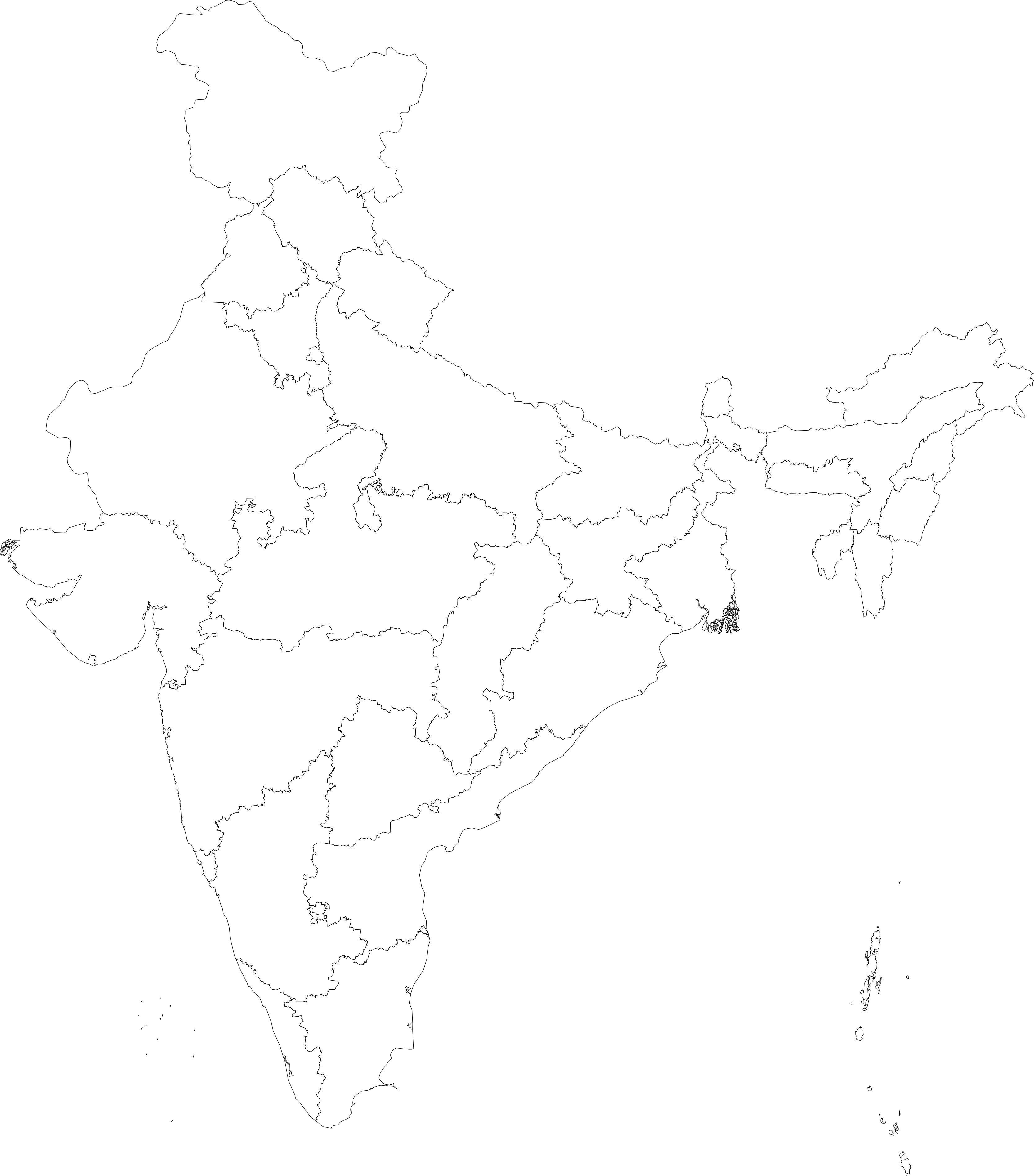
11%
Rejections in New Delhi
Top 2 Rejection Reasons in New Delhi Consulate
approval chances
if corrected
Documentation
68%
+60%
Approval chances if corrected
+60%
Others
32%
+54%
Approval chances if corrected
+54%
Recognized Patterns in New Delhi Consulate
Document with most weight
Employment proof
Lower sensitivity to
Travel history
Rejection Reasons Decoded
Your rejection letter often lists vague reasons for refusal. We’ve translated them so you know exactly what to fix before reapplying.
Consulate Reason
Decoded
Ideally Re-apply in
Financial Thresholds
Your trip must be financially backed, with enough margin to cover your stay comfortably. Consulates evaluate this as a trip-to-finances ratio. Use this calculator to see what your finances should look like.
enter trip details
Accommodation Type
Number of Countries
Number of Days
Ideal Financial Strength to Meet Approval Threshold
See how similar applications performed
filter to view profiles
Profile Thresholds
Consulates evaluate applications based on financial strength, travel history, and profile stability. This tool estimates your chances of approval based on similar applicant profiles.
0%
Approval rate
for similar profiles
enter profile details
Marital Status?
Gender
First time visiting Latvia?
Your age
Countries Visited in the Past
Assets Owned in India
Income Range
Economic Signals
Visa decisions are also influenced by broader economic signals — like overstay rates, currency strength, and return likelihood. These factors help embassies assess overall risk from applicants.

India Travelers Who Overstay Their Visa
This percentage is below global average. Positive signal for your application.
1.5%
Below global average


Foreign Exchange Impact
A stronger rupee means your savings show higher value in the destination currency, which can help meet visa financial thresholds
€1→ ₹108.22
1% in 90 days

How Likely Applicants Are to Return to India
Embassies assess "will this person return home?" India's economic growth and job market signal a higher likelihood of applicants returning home.
Strong
Top 5 economies
Geopolitical Signals that work for and against you
India currently
Feb
2024
Feb 2024
Latvia's elevated threat posture tied to Russia/Belarus border pushed stricter Schengen issuance defaults, lengthening processing for Indian short-stay applicants.
border scrutiny
Sep
2024
Sep 2024
Riga's IT sector, anchored by Northern European BPO clusters, began structured Indian recruitment drives for mid-senior specialist roles — a positive work-visa signal.
specialist approvals
Jan
2025
Jan 2025
Latvian authorities signalled reduced issuance of Golden-Visa-style investor residence instruments, marginally cutting Indian HNI pathway volumes.
investor flow
May
2025
May 2025
Latvia aligned with EU-wide move to tighten agency-based worker flows, raising employer-vetting costs for Indian recruiters targeting Baltic placements.
agent filtering
Sep
2025
Sep 2025
Baltic–India tech dialogue in Riga lifted startup and research visibility, creating a nascent positive channel for niche long-stay approvals.
niche approvals
Frequently Asked Questions

Reapplication & Timeline
Can I reapply for a Latvia Schengen visa after rejection?
Yes, you can reapply for a Latvia Schengen visa after rejection. There is no mandatory waiting period between applications under the EU Visa Code (Regulation (EC) No 810/2009). However, reapplying without fixing the specific reasons for your rejection is the most common and costly mistake — over 1.65 lakh Schengen visa applications from India were rejected in 2024 (European Commission visa statistics, CY2024), with Indian applicants collectively losing an estimated ₹136 crore in non-refundable visa fees that year alone.
What you need to know:
Every Schengen rejection cites Article 32 of the EU Visa Code — the legal basis for refusal — and lists specific grounds checked on the standard refusal form
The Latvia consulate has full visibility of your prior refusals through the Visa Information System (VIS), the shared EU database accessible to every Schengen consulate
In 2026, Schengen visa evaluation has shifted from a document-checklist approach to a holistic risk assessment model — with the EU Entry/Exit System (EES) rollout, your entire profile is cross-referenced digitally before a human reviews your file
The average approval rate for Indian applicants across all Schengen countries is approximately 84.6% — meaning about 1 in 7 Indian applicants get refused
A strong reapplication directly addresses every concern listed on the refusal form with credible new evidence
Atlys decodes your Latvia refusal letter, identifies which of the 9 Article 32 grounds were cited, and rebuilds your application with new evidence. Apply for your Latvia visa through Atlys
Related reading: Schengen visa rejection reasons for Indians — the complete 2026 guide
How long should I wait before reapplying for a Latvia visa?
The wait depends entirely on what caused your refusal. Reapplying too quickly without genuine improvement signals that the underlying issue is unresolved — and consular officers see when prior applications were submitted through the VIS database.
Photo or document format failures — 1 to 2 days to correct and resubmit
Travel insurance errors (coverage gaps, insufficient amount, non-recognised provider) — 1 to 2 days once a Schengen-compliant policy is in place
Missing or incomplete documents — 1 to 2 weeks
Travel purpose or itinerary issues — 2 to 4 weeks to build a credible plan and cover letter
Financial proof or ties-to-India failures — 4 to 8 weeks to build organic bank activity and a stronger evidence profile
Article 32(1)(b) doubts about intention to leave — 4 to 8 weeks of profile-building plus targeted cover letter rebuild
Misrepresentation findings under Article 32(1)(a) — specialist review required; do not reapply without addressing the underlying finding
Standard Latvia consulate processing is 15 calendar days under Article 23 of the Visa Code, extending to 30 days in cases requiring further examination and up to 45 days in exceptional cases. Atlys provides a specific recovery timeline after reviewing your refusal letter.
Reapplication guide: My Schengen visa got rejected — how can I apply again?
Can I appeal a Latvia Schengen visa rejection?
Yes, every Schengen visa rejection comes with a statutory right of appeal under Article 32(3) of the EU Visa Code. The Latvia refusal letter specifies the appeal procedure and deadline — typically 15 to 30 days depending on the issuing country.
Your practical options:
Formal appeal to the Latvia consulate or competent court — possible within the specified deadline (usually 15 to 30 days); requires a written appeal letter explaining why the decision was wrong, with supporting evidence
Reconsideration request — informal route requesting the consulate to review the decision, typically faster but less formal than a full appeal
Rebuilt reapplication — the practical recovery path for most refusals, often quicker than the appeal process and with a higher success rate when the file is substantially improved
When to appeal vs reapply:
Appeal when you firmly believe the rejection was based on a clear error, when you have strong evidence the officer overlooked, or when you can provide additional documentation that directly contradicts the stated rejection reason
Reapply when the rejection reason can be addressed with new or corrected information, when you don't have strong grounds to argue the original decision was wrong, or when speed matters (appeals can take months)
In most cases, a well-rebuilt reapplication that directly addresses every concern from the original refusal letter is dramatically faster and more effective than a formal appeal. Atlys assesses whether your specific case warrants formal appeal or whether reapplication is the right strategy.
How many times can I reapply for a Latvia Schengen visa after rejection?
There is no official cap on Schengen visa reapplications, but the Latvia consulate — like every Schengen consulate — takes a progressively more critical view of applications where the same weakness persists across multiple submissions.
Key facts about multiple rejections:
Each application incurs the Schengen visa fee of €90 (around INR 8,500) for adults, plus VFS service fees
Indians collectively spent ₹136 crore in non-refundable Schengen visa fees in 2024 — a significant share from repeated unsuccessful applications
Refusal records are stored in the Visa Information System (VIS) and visible to every future Schengen consular officer across all 29 Schengen states
Repeated refusals for the same reason signal unresolved underlying issues, making future approvals significantly harder
After a second refusal, the third application faces heightened scrutiny on every section of the file
After a second refusal, a professional review is essential before attempting a third application. Atlys handles multi-rejection Schengen recovery as a specialist case — auditing both prior applications, identifying what persisted across attempts, and building a submission materially different from both prior tries.
Should I declare my previous Latvia visa rejection in my new application?
Yes. The Schengen visa application form asks whether you have previously been refused a visa to any Schengen state or other country. You must answer honestly.
Why honest disclosure is non-negotiable:
The Visa Information System (VIS) stores every Schengen visa application and decision across all 29 Schengen states — your prior refusal is visible to the Latvia consulate regardless of which country issued it
Concealing a prior refusal is treated as misrepresentation under Article 32(1)(a) of the EU Visa Code — a significantly more serious ground for refusal than the original rejection
A misrepresentation finding triggers automatic refusal and is recorded permanently in the VIS, affecting future applications across the entire Schengen area
For document-level rejections that were corrected, honest disclosure paired with the corrected application is standard procedure
For more serious rejections (Article 32(1)(b) doubts about intention to leave, financial concerns), the disclosure must be carefully framed with supporting documentation
Acknowledging the prior refusal and demonstrating what has been corrected and improved is the correct and more effective approach. Atlys structures the disclosure as part of a rebuilt cover letter that directly addresses the prior refusal.
Rejection Reasons & Fixes
What are the most common reasons for Latvia Schengen visa rejection for Indian applicants?
Based on Atlys case data spanning 2M+ applications processed across 150+ destinations, and aligned with European Commission patterns for Indian applicants, the highest-frequency Schengen rejection grounds under Article 32 of the EU Visa Code are:
Weak proof of intent to return to India — Article 32(1)(b); the dominant rejection ground across all Schengen countries
Insufficient or inconsistent financial proof — low balances, sudden large deposits, income that doesn't match declared occupation
Unclear or unverifiable travel purpose — vague itineraries, missing hotel confirmations, missing return tickets, mismatch between declared duration and actual bookings
Travel insurance errors — coverage gaps, amount below €30,000, policies not valid across all 29 Schengen states
Inconsistent documents — dates, names, or amounts that don't align between the application form, supporting documents, and itinerary
Information regarding the purpose and conditions of the intended stay was not reliable — Article 32(1)(a)
Passport validity or condition issues — less than 3 months beyond intended departure, fewer than 2 blank pages, damaged or older than 10 years
Misrepresentation — fake documents, concealed prior refusals (permanent VIS record)
Wrong consulate — applying to a country that's not your main destination (the country where you'll spend the most nights)
VIS data anomalies — inconsistencies between current application and stored VIS data from prior applications
Weak proof of intent to return is by far the largest single category of refusals for Indian applicants — accounting for the majority of Article 32 refusals across Latvia and other Schengen consulates.
Deep dive: Main Schengen visa rejection reasons and how to avoid them
My refusal letter says I didn't prove intent to return to India. How do I fix this?
This is Article 32(1)(b) of the EU Visa Code — the consular officer was not convinced you would leave Latvia (and the Schengen area) at the end of your authorised stay. It's the dominant rejection ground for Indian applicants and reflects on the credibility of your entire application.
What the officer is assessing:
Your economic situation in India — employment, income, assets, financial stability over time
Your personal ties — family, property, obligations that require your return
Your immigration history — prior travel, prior refusals, prior compliance with visa rules
The overall credibility of your stated purpose
Common triggers:
Short employment tenure — under 1 year at current job, no demonstrated stability
Limited financial stake in India — no property, no business interests, minimal savings
No family obligations — single applicant with no dependents
Implausible travel plan — duration or destinations don't match your profile
Pattern of long stays elsewhere — frequent or extended stays in other countries that suggest migration intent
Application timing — applying just after losing a job, completing studies, or other life transition that suggests potential migration intent
The fix:
Build a comprehensive ties-to-India file — employer letter with return-to-work confirmation, property documents, fixed deposits, dependent family proof, business interests, running EMIs
Submit a detailed cover letter explaining why you are returning to India after the trip
Build a credible itinerary that matches your professional and financial profile
Demonstrate ongoing commitments in India — running loans, business contracts, professional obligations
Reference past international travel compliance — Schengen, UK, US, or other travel where you departed on time
Atlys rebuilds Article 32(1)(b) cases with a comprehensive ties profile and a targeted cover letter that directly addresses the intent-to-return test.
What financial documents does the Latvia consulate expect?
The Latvia consulate assesses your financial profile to confirm you can fund your trip independently without working or accessing public funds, and that you have a stable economic base in India. Indian applicants must demonstrate consistent financial stability over time — not just a balance on a single day.
Required financial documents:
6 months of bank statements — consistent organic activity showing salary credits, regular expenses, and maintained balance (preferably stamped by the bank)
ITR filings — last 2 to 3 years, consistent with bank statement activity
Salary slips — last 3 to 6 months for salaried applicants
Form 16 — for the most recent financial year
Investment statements — FDs, mutual funds, demat holdings
Property valuation documents — if relevant
Sponsor's financial documents — if someone else is funding your trip
Schengen funds benchmark:
The Schengen area's general guideline is EUR 50 to EUR 100 per day per applicant, varying by destination:
Lower-cost Latvia options (Italy, Spain rural areas, Portugal) — around EUR 50 to 70 per day
Mid-range (Latvia city stays, Germany, Austria) — around EUR 70 to 100 per day
High-cost (Switzerland, France Paris, Norway) — EUR 100+ per day
For a standard 10-day trip, accessible funds of approximately EUR 1,000 to 1,500 (around INR 90,000 to 1,35,000) are recommended. The consulate assesses the full financial picture rather than a single number.
Red flag patterns (Atlys case data):
Sudden large deposits made close to the application date — interpreted as "show money" arranged for the visa rather than genuine funds
Income doesn't match bank credits — payslips showing one figure while bank statements show another
Balance inconsistent with declared occupation — disproportionate to declared salary
Limited transaction history — accounts with very few transactions suggest the bank isn't your primary financial record
Funds borrowed shortly before application — without source documentation, treated as insufficient
Atlys reviews your full financial profile against Latvia assessment standards and rebuilds the financial evidence stack with appropriate justification.
What are the Latvia travel insurance requirements?
Travel insurance errors are among the most common reasons for outright rejection. The Schengen visa requires very specific coverage, and many Indian travel insurance policies don't meet the standard.
Mandatory Schengen insurance requirements:
Minimum coverage of EUR 30,000 for medical emergencies, hospitalisation, and repatriation
Valid across all 29 Schengen states (not just Latvia)
Covers the entire period of your intended stay or transit in the Schengen area
Covers repatriation for medical reasons, urgent medical attention, emergency hospital treatment, or death during the stay
Issued by a recognised provider — the Latvia consulate maintains a list of approved Indian travel insurance companies
Exact date alignment with your travel dates (even a one-day gap is grounds for refusal)
Common insurance rejection triggers:
Coverage amount below EUR 30,000
Dates not exactly matching travel dates — coverage starting one day after your arrival or ending one day before your departure
Missing repatriation or emergency medical evacuation coverage
Insurance provider not recognised by the Latvia consulate
Policy valid only in Latvia but not across the full Schengen territory
Wrong policy type — domestic travel insurance instead of international Schengen-compliant insurance
The fix:
For a multiple-entry visa, ensure your travel insurance covers your first trip and remains renewable for subsequent trips. Atlys provides Schengen-compliant travel insurance directly through the platform — pre-configured to meet all requirements including correct coverage amount, full Schengen territory, exact date alignment, and repatriation coverage included.
What counts as strong ties to India for a Latvia visa?
Ties to India are the foundation of any Schengen visitor visa application. The Latvia consulate assesses these under Article 32(1)(b) — the officer must be satisfied you will leave the Schengen area at the end of your visit.
What qualifies as a strong tie:
Current employment — appointment/experience letter, last 6 months' payslips, leave approval with exact dates, company contact details, return-to-work confirmation
Self-employment — business registration (GST/VAT if applicable), latest ITRs, invoices and matching bank credits
Property ownership — sale deed, property registration, deeds/leases in your name
Fixed deposits or significant investments — FD certificates, mutual fund statements
Family obligations in India — spouse, children, dependent parents (with proof: marriage certificate, birth certificates)
Active business interests — registered business, GST registration, partnership deed
Financial or contractual obligations — running EMIs, business contracts, ongoing professional commitments
Ongoing education — for student applicants, current enrolment proof
Critical principle:
Each tie must be documented specifically and currently. Vague or undated claims carry little weight with Latvia officers. A combination of at least two to three strong tie types significantly improves your application strength.
For students or first-time travellers with limited ties:
Strong sponsor documentation from parents (with their bank statements, ITR, employment proof, and notarised affidavit of support)
Educational enrolment proof showing return to study after the trip
Clear timeline showing the trip falls within a defined break
Atlys audits your ties profile against Latvia consulate standards and identifies where reinforcement is needed.
My refusal letter says my travel purpose was not established. How do I fix this?
This means the Latvia consulate was not convinced your trip was genuine or that your travel plan was clear and credible. Schengen short-stay visas allow specific activities — tourism, visiting friends or family, business meetings, conferences, short courses, medical treatment, and certain other permitted activities — and your application must clearly align with one of these.
Common triggers:
Vague cover letter with no specific itinerary
Missing hotel bookings or partial-stay coverage
Flight bookings that don't match your stated purpose
Travel plan inconsistent with your financial or professional profile
Booking a family visit without an invitation letter from your Schengen host
Real purpose is something the short-stay visa doesn't cover (work, long-term study, or settlement) — this is a refusal risk and potentially misrepresentation
The fix:
Write a stronger cover letter with a specific day-by-day plan covering every night of your stay
Provide confirmed hotel bookings for every night across every Schengen country you'll visit
Submit return flight tickets matching your itinerary (use refundable bookings until the visa is approved — do not buy non-refundable flights upfront)
Build a clear narrative connecting your trip purpose to your professional and financial profile
For family or business visits, add a detailed invitation or host letter with relationship proof and the host's Schengen status documents
Ensure your visa route matches your actual purpose
Atlys writes a targeted cover letter that directly addresses the prior refusal and builds a credible, evidence-backed travel narrative.
I applied to the wrong Schengen consulate. What does this mean?
Under Schengen rules, you must apply to the consulate of your main destination — the country where you'll spend the most nights, or the country with the primary purpose of your trip. If no main destination can be determined, you apply to the country of first entry.
Why this matters:
Applying to the wrong consulate is a procedural ground for refusal under Article 32 of the EU Visa Code
Indian applicants sometimes apply to a Schengen country with the lowest perceived rejection rate (Iceland, Lithuania, Slovakia, Romania) for a trip primarily to Latvia — this is identified as misrepresentation and triggers refusal
Border officers cross-check your visa-issuing country against your actual itinerary at entry — material mismatch can result in entry refusal, visa annulment, or revocation
The "main destination" rule:
If your trip covers multiple Schengen countries, calculate which country you'll spend the most nights in. That's where you apply.
Example: A 14-day trip with 3 nights in Paris, 4 nights in Rome, and 7 nights in Madrid means Spain is your main destination — you must apply to the Spanish consulate, not France or Italy.
The fix:
Identify your true main destination based on number of nights
Apply to the correct consulate for your next application
Submit consistent itinerary showing your stay distribution clearly
Do not shift planned destinations after visa issuance — material changes can trigger visa annulment at the border
Atlys verifies main destination eligibility before submission to prevent procedural refusals.
My passport was flagged as not meeting Schengen requirements. What do I need?
The Schengen passport requirements are strict, and minor non-compliance triggers automatic refusal under Article 32 of the EU Visa Code.
Mandatory passport requirements:
Valid for at least 3 months beyond your intended departure from the Schengen area
At least 2 blank pages for visa sticker and entry/exit stamps
Issued within the last 10 years — passports older than 10 years are not accepted even if technically valid
Not damaged, torn, or with water damage
Personal details consistent with your supporting documents (no name mismatches, no incorrect birthdates)
Common passport rejection triggers:
Passport expiring within 3 months of intended Schengen departure
Only 1 blank page or all pages full
Passport issued more than 10 years ago (relevant for some older Indian passports)
Visible damage — water damage, torn pages, separated binding
Mismatch between passport name and other documents — usually due to single-name applicants or post-marriage name changes
For Indian passport holders living abroad (UAE, US, UK) — missing proof of legal residence in that country
The fix:
Renew your passport before applying if any validity, blank pages, or condition issue exists
For single-name applicants — refer to Atlys's country-specific guides for handling MRZ formatting and supporting documents
For post-marriage name changes — submit marriage certificate and updated documents reflecting both names
For Indian passport holders abroad — submit proof of legal residence in the country you're applying from
Atlys verifies passport compliance against Schengen requirements before submission.
What photograph specifications does the Latvia consulate require?
Schengen photo requirements are standardised across all 29 countries and are precise — using the wrong dimensions or format is a frequent automatic rejection trigger.
Required photo specifications:
Size: 35mm × 45mm
Background: plain white or light grey, evenly lit with no shadows
Recency: taken within the last 6 months
Face: clearly visible, head occupying 70 to 80 percent of the photo
Glasses: not permitted
Headwear: not permitted except for religious reasons with full face visible (face must be visible from bottom of chin to top of forehead, and edges of face visible)
Expression: neutral, mouth closed, no smiling
Format: colour, in JPEG
Quality: high resolution, unedited, suitable for biometric recognition
Common photo rejection triggers:
Wrong dimensions — Indian passport size (35×45) is correct, but cropping errors are common
Coloured or patterned backgrounds instead of white or light grey
Head occupying wrong proportion of the photo (too small or too large)
Glasses worn (even non-reflective ones)
Photos taken too long ago — over 6 months
Edited or filtered images — biometric recognition fails
Shadows on face or background from uneven lighting
The fix:
Use a recent, high-quality photo taken within the last 6 months and verified against Schengen specifications before submission. Atlys verifies photo specifications against Latvia consulate requirements before submission, with a photo specification check built into the application workflow.
Documents & Application Requirements
What documents are required to reapply for a Latvia visa after rejection?
Core document set for a Latvia Schengen short-stay visa reapplication:
Passport — valid for at least 3 months beyond intended Schengen departure, with at least 2 blank pages; issued within the last 10 years; copies of all old passports if applicable
Photograph — 35mm × 45mm meeting Schengen specifications (see Q14)
Application form — Schengen visa application form, completed and signed
Financial documents — 6 months of bank statements (stamped by bank), ITR for last 2-3 years, salary slips for last 3-6 months, Form 16, investment statements
Employment proof — employer letter on letterhead with designation, salary, approved leave dates matching travel exactly, return-to-work confirmation
Self-employed documents — business registration, GST filings, latest ITRs, invoices and matching bank credits
Ties to India — property documents, FD certificates, dependent family proof
Travel documents — confirmed return flight itinerary (refundable bookings until visa is approved), hotel bookings for every night, day-wise itinerary
Travel insurance — Schengen-compliant policy covering minimum EUR 30,000, valid across all 29 Schengen states, exact date alignment with travel
Cover letter — directly addressing prior refusal reasons and what has materially changed
For family visit applications, add:
Invitation letter from Latvia-based host (status, address, relationship, purpose, financial undertaking if applicable)
Host's Schengen status documents (passport, residence permit, or visa copy)
Proof of relationship (birth certificate, marriage certificate)
For sponsored applications, add:
Sponsorship letter with exact support details and dates
Sponsor's ID and last 6 months of bank statements
Sponsor's employment or tax documents
Notarised affidavit of financial support
For students, add:
Bonafide certificate from institution
Sponsor's financial documents and ITR
Sponsor's relationship proof
The critical step in any reapplication: fix the specific weakness that caused the previous rejection. Submitting the same flawed file with cosmetic changes is the most common reason for second-time refusals.
Country-specific context: Top 10 Schengen visa rejection reasons and quick fixes
What should a strong employer letter for a Latvia visa include?
A strong employer letter is one of the most important pieces of evidence for a Latvia Schengen visa application — it directly supports your intent-to-return status under Article 32(1)(b).
A strong employer letter must include:
Your full name and current designation
Date of joining and current employment status (permanent or contract)
Approved leave dates matching your travel dates exactly
Monthly salary or annual CTC
Clear statement that the company approves your Latvia travel
Return-to-work confirmation — explicit statement that your position will be held for you on return (the most commonly missed element)
Authorised signatory's name, designation, and signature
Issued on company letterhead with full address and contact details
Dated within 30 days of your application submission
For self-employed applicants, replace with:
Business registration certificate (GST/VAT registration if applicable)
Last 2 to 3 years' ITR
Recent invoices with matching bank credits
Business bank statement showing active trading activity
Self-declaration on company letterhead explaining your role and travel purpose
Why employer letters fail Schengen-specific scrutiny:
Vague letters without specific leave dates, missing salary information, no return-to-work confirmation, or signed by an unauthorised person are among the most frequently flagged documents. The letter must anchor your professional ties to India clearly — if it doesn't, the officer treats it as insufficient evidence under Article 32(1)(b).
How does Atlys help recover a Latvia visa after rejection?
Atlys handles Latvia Schengen rejection recovery as a structured, multi-step process designed around the specific failure point in your previous application:
Step 1 — Diagnostic review. We read your refusal letter line by line, identify which of the 9 grounds under Article 32 of the EU Visa Code were cited, and map each refusal reason to specific gaps in your previous file.
Step 2 — Profile assessment. We evaluate your current profile against Latvia consulate standards — financial depth, ties to India, immigration history, travel purpose credibility — and determine whether reapplication is achievable on your current profile or whether 4 to 8 weeks of profile-building is required first.
Step 3 — Personalised recovery plan:
Photo or document format failures: Schengen-compliant photo and documents prepared; resubmitted within 1 to 2 days
Travel insurance errors: Schengen-compliant policy provided directly through Atlys (EUR 30,000+ coverage, full Schengen territory, exact date alignment, repatriation included)
Financial profile rebuild: Bank statement quality strengthened, ITR consistency verified, fund-source justifications prepared with supporting evidence
Ties-to-India strengthening: Employment, property, financial, and family ties documented comprehensively
Article 32(1)(b) intent-to-return cases: Targeted cover letter and ties profile rebuilt to address the test directly
Targeted cover letter: Directly addressing every concern from the prior refusal letter
Travel purpose narrative: Confirmed bookings, day-wise itinerary, credible plan aligned with your professional profile
Main destination verification: Confirmed correct Latvia consulate based on actual itinerary
Misrepresentation cases (Article 32(1)(a)): Specialist handling with full disclosure framing
Step 4 — Expert review and submission. A dedicated visa expert audits the rebuilt file before submission. Standard Latvia consulate processing then takes 15 calendar days (up to 30 in extended cases, 45 in exceptional cases).
Recovery timelines:
Photo, insurance, or format failures: 1 to 2 days
Missing document cases: 1 to 2 weeks
Travel purpose cases: 2 to 4 weeks
Financial or ties-to-India cases: 4 to 8 weeks of profile-building
Why Atlys handles Latvia Schengen recovery effectively:
AtlysProtect refund protection on qualifying applications — refund even if the application is rejected (free)
Built-in Schengen-compliant travel insurance meeting all EU requirements
Photo compliance check built into the application workflow
Disclosure-first reviews — every previous refusal correctly disclosed in VIS-aligned format
Cover letter writing tuned to Article 32(1)(b) intent-to-return standards
~99.2% delivery prediction accuracy backed by 2M+ applications processed across 150+ destinations
~90% faster processing than traditional channels
Money-back protection on supported categories
Exclusive MakeMyTrip flight partnership for refundable flight bookings meeting Schengen requirements
On-ground presence in India, UAE, Great Britain, Vietnam, and Philippines
Talk to an expert
Not sure if you should reapply? Get a free reapplication strategy.
Rejection Recovery
If your application is rejected again, we refund every rupee - no questions asked.
Government Fee
₹2,690
Mandatory fee set by Latvia
Atlys Fee
₹8,832
Approval Guarantee Fee (incl. 18% GST)
Total Amount
₹11,522
Atlys Protect
If your application is rejected again, we refund every rupee