Worried your German visa photo might get rejected? You're not alone.
Many travellers encounter issues because of simple photo errors, such as the wrong background colour, face size, or poor lighting. These small mistakes can lead to delays or even visa rejections.
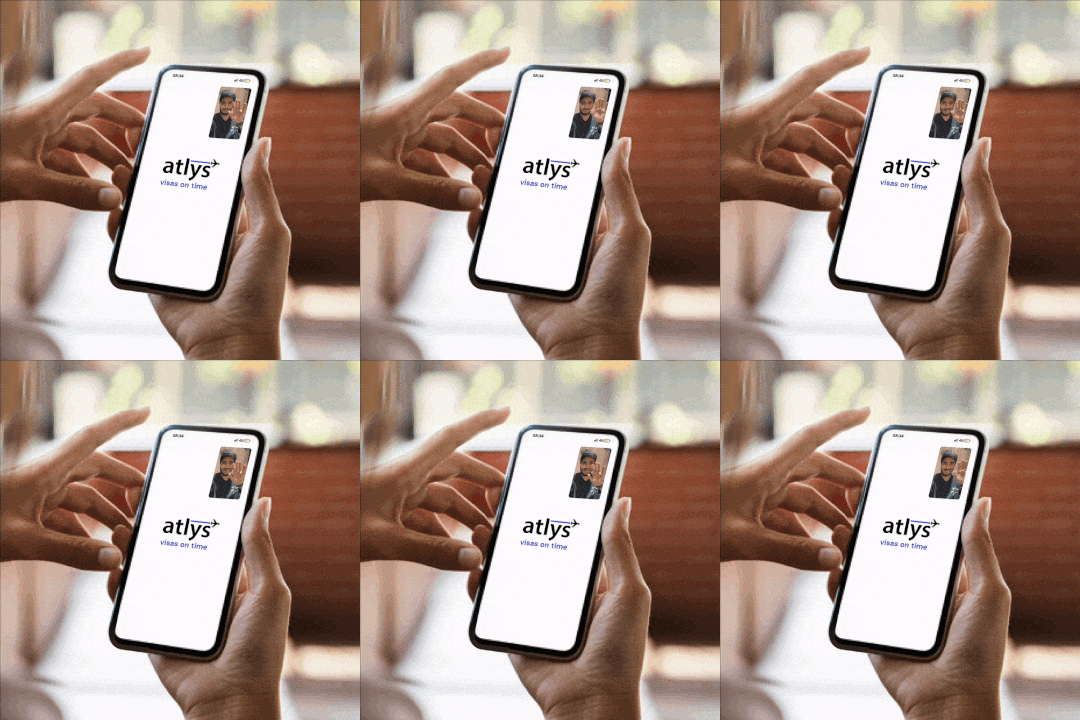
If you're applying for a German visa, ensuring your photo meets the embassy guidelines is crucial. That’s why Atlys developed the Germany Visa Photo Maker Tool to take the guesswork out of the process. The tool automatically adjusts your photo to meet official requirements, saving time and preventing avoidable setbacks.
In this guide, we’ll show you how to use the tool and walk you through the full list of photo specifications for your German visa application.
Germany Visa Photo Requirements
Here are the official passport photo specifications for a German visa:
Size: 35 × 45 mm
Format: JPEG/JPG; high-quality print (matte or glossy)
Background: Plain, light (white or light grey)
Face Size: 32–36 mm (70–80% of photo height)
Borders: No borders
Recency: Taken within 6 months
Orientation: Full-frontal, head centred
Quality: Sharp, well-lit, no shadows or red-eye
Expression: Neutral, mouth closed, no smile
The Atlys visa photo tool handles all these specifications automatically.
German Visa Photo Size
The German visa photo size must measure 35mm in width and 45mm in height (1.38 x 1.77 inches, 3.5 cm x 4.5 cm in cms). The width of the face shall be between 16 mm and 20 mm from ear to ear.
To ensure accurate facial recognition and verification, the face, from the bottom of the chin to the top of the crown (not the top of the hair), as well as the left and right sides of the face, should occupy 70% to 80% of the total photograph.
Note: Photos will be rejected if the face measures less than 27 mm or more than 40 mm.
Resolution
The resolution of the German visa photo should be 400 dpi, so when the image is scanned or uploaded, check this parameter carefully. However, the higher the resolution, the bigger the picture.
The photo must be in sharp focus, clear, undamaged and of high quality with no ink marks or creases
Format
For online Germany visa applications, the digital photo must be in JPG or JPEG format and should not exceed 120 KB in file size. Submitting files in unsupported formats such as BMP, TIFF, GIF, or PDF may result in application rejection. Photos can be black or white or color.
Photograph quality
The photo must be printed on high quality paper with a resolution of atleast 600 dpi [if clicked on digital camera]. The color photograph must have proper color balance (approriate brightness and contrast) and show natural skin tone.
The photograph must show only the applicant [no other persons or objects in the photograph].
Note: Digital camera photographs must be high-quality, in color, and printed on photo-quality paper preferably not glossy
Background
Photo background must be plain and light so that facial features are distinguishable and contrast against the background.
In the case of light coloured hair, a medium grey background is suitable and in the case of dark hair, light grey background is suitable. The background should not be patterned. And shadows on the background is not acceptable.
The Germany visa photo must not have any borders or extra margins. A clean, borderless image ensures it meets official formatting requirements and is suitable for biometric processing.
Recent Photo:
Your photo must be taken within the last six months to accurately reflect your current appearance. If there have been any noticeable changes, such as a drastic haircut or significant alteration to facial hair, a new photo may be required to avoid delays or issues with the German visa application or identification.
Style and Lighting
Photographs must be taken with even lighting. Shadows, reflections and red-eye are not acceptable.
The eyes in the photograph should be open and clearly visible. No hair across the face or eyes.
Eyes must be in the upper half of the photograph (minimum distance between the center of the two eyes: 8mm)
Expressions and Frame
You should show your face square on to the camera, no portrait style (not looking over ones shoulder) or tilted and showing both edges of face clearly. The facial expression must be neutral, mouth closed and looking directly at the camera.
Glasses:
If you wear glasses for medical reasons, you must show your eyes clearly no reflections and no tinted lenses They should not create glare or obscure the eyes, as reflections can interfere with biometric accuracy. The edge of glasses or lenses should not cover any part of the eyes
Head Covers
Head coverings are only allowed for religious or medical reasons. They must be plain, pattern-free, and not obscure any facial features. The full face, from the bottom of the chin to the top of the forehead, must be visible, including the edges. Shadows on the face are not acceptable
Germany Visa Photo Requirements for Minors
Babies under one year old don’t need open eyes.
The photo must be high quality and front-facing.
For children under 9, the face should take up to 50-80% of the photograph.
The face from the bottom of the chin to the top of the head (not hair)should measure between 22mm and 36mm
Children under age 5 do not need to have neutral expressions or look directly into the camera, and their heads don’t have to be centred in the photo
The frame should not show hands, toys, a chair or other people—only the child.
Ensure the child's face is clear and facing forward.
Please note: If the child or baby needs support, the support must not be visible in the photo. The supporting hand can be hidden under the child’s clothing.
How do you take a German visa-compliant photo at home?
You can take your German visa photo from the comfort of your home using the Atlys Germany Visa Photo Maker Tool. Here’s how:
Take or Upload Your Photo: You can start by uploading a photo in JPEG, JPG, or PNG format, or you can take a new one using your phone or webcam.
Click "Transform": Once uploaded, click the “Transform” button. Based on German visa requirements, the tool will automatically adjust the photo's background, size, lighting, and alignment.
Download Your Photo: After processing, download the final version and attach it digitally or as a printed copy to your visa application.
Now that your photo is done correctly, you can confidently move forward with your German visa application. Atlys makes that part easy, too.
Do's and Don’ts for German Visa Photos
Do’s
Use even lighting with no shadows.
Make sure the photo is recent (within 6 months).
Keep a neutral expression with your mouth closed.
Ensure your shoulders and hair are visible.
Use a plain white or light grey background.
Wear dark-colored headwear only for religious reasons, and ensure the face is fully visible.
If wearing glasses, ensure your eyes are fully visible with no reflections.
Don’ts
Don’t submit damaged or creased photos.
Don’t let hair cover your eyes or face.
Avoid red-eye, colored lenses, or tinted glasses.
Don’t wear sunglasses.
Don’t tilt your head; keep it straight and centered.
Can I take my Germany visa photo at home?
Yes. You can take or upload a photo using the Atlys Germany Visa Photo Maker Tool. The tool automatically adjusts background, size, and alignment to meet the German embassy's requirements.
Can I wear glasses in my Germany visa photo?
Yes, but only if the lenses are clear, with no glare or reflections, and your eyes are fully visible. Tinted or colored lenses are not allowed.
Are head coverings allowed in the photo?
Yes, but only for religious reasons. Headgear must not cast shadows or hide facial features. Your full face, from forehead to chin, must be visible.
What are the most common mistakes to avoid?
Common mistakes include smiling, poor lighting, shadows, the wrong background, head tilting, and using old or damaged photos. The Atlys photo tool helps avoid all of these.
What are the visa photo requirements for neighbouring Schengen countries?
Here are the visa photo requirements for neighbouring Schengen countries:
Czech Republic
How we reviewed this tool:
Our experts continually monitor the official sources for any changes, and we update our articles when new information becomes available.
- Current Version
14 Oct 2025
Written By:
Jyoti Bhatt
Edited By:
Arun Kumar Gundu
16 Apr 2025
Written By:
Jyoti Bhatt
Edited By:
Jyoti Bhatt