Rejection Recovery
If your application is rejected again, we refund every rupee - no questions asked.
Government Fee
₹1,250
Mandatory fee set by Japan
Atlys Fee
₹7,965
Approval Guarantee Fee (incl. 18% GST)
Total Amount
₹9,215
Atlys Protect
If your application is rejected again, we refund every rupee
Talk to an expert
Not sure if you should reapply? Get a free reapplication strategy.
 Data sourced from over 24,000+ Atlys applications
Consulate Specific Data
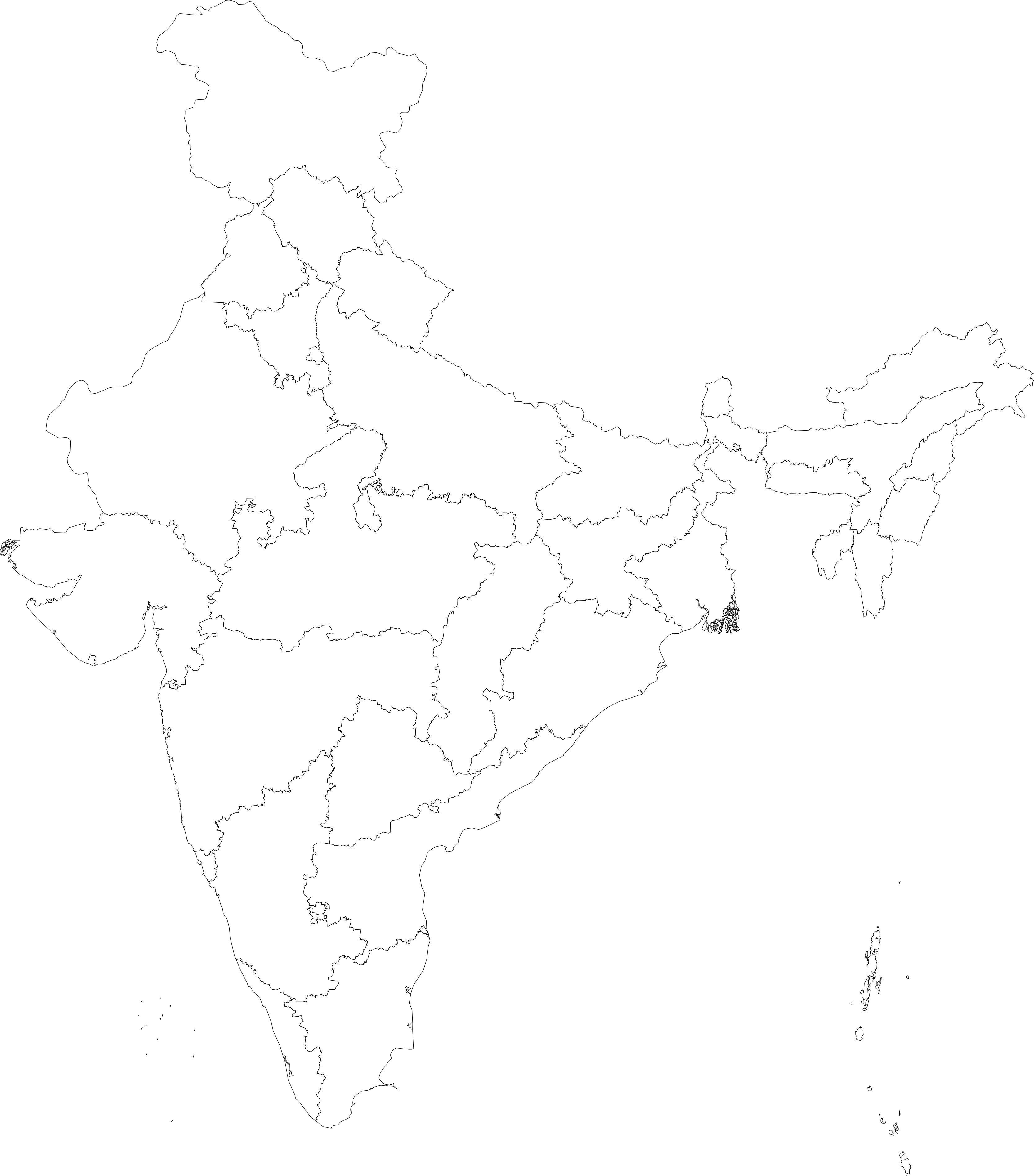
We’ve identified consulate-specific patterns across India based on which profiles get approved or rejected. This helps pinpoint exactly where your application needs to be stronger.
8%
Rejections in New Delhi
Top 4 Rejection Reasons in New Delhi Consulate
approval chances
if corrected
Delayed Documents (Bank Statement / NOC)
40%
+80%
Approval chances if corrected
+80%
Financial Proof
28%
+74%
Approval chances if corrected
+74%
Documentation
22%
+72%
Approval chances if corrected
+72%
Others
10%
+60%
Approval chances if corrected
+60%
Recognized Patterns in New Delhi Consulate
Bank statements
6 months minimum required
Document with most weight
Employer NOC + confirmed itinerary
Lower sensitivity to
Prior travel history to Japan
Financial Thresholds
Your trip must be financially backed, with enough margin to cover your stay comfortably. Consulates evaluate this as a trip-to-finances ratio. Use this calculator to see what your finances should look like.
enter trip details
Accommodation Type
Number of Days
Ideal Financial Strength to Meet Approval Threshold
See how similar applications performed
filter to view profiles
Profile Thresholds
Consulates evaluate applications based on financial strength, travel history, and profile stability. This tool estimates your chances of approval based on similar applicant profiles.
0%
Approval rate
for similar profiles
enter profile details
Marital Status?
Gender
First time visiting Japan?
Your age
Countries Visited in the Past
Assets Owned in India
Income Range
Economic Signals
Visa decisions are also influenced by broader economic signals — like overstay rates, currency strength, and return likelihood. These factors help embassies assess overall risk from applicants.

India Travelers Who Overstay Their Visa
This percentage is below global average. Positive signal for your application.
1.2%
Below global average


Foreign Exchange Impact
A weaker rupee means your savings show lower value in the destination currency, which can affect visa thresholds
¥1→ ₹0.61
4% in 90 days

How Likely Applicants Are to Return to India
Embassies assess "will this person return home?" India's economic growth and job market signal a higher likelihood of applicants returning home.
Strong
Top 5 economies
Geopolitical Signals that work for and against you
India currently
Jan
2026
Jan 2026
A spike in visa misuse cases by some agents triggered tighter document verification, marginally raising rejection rates on first-time tourist applications.
scrutiny (tourist)
Oct
2025
Oct 2025
Annual leaders' summit produced a fresh mobility pact targeting 50,000 Indian skilled workers over five years, focused on semiconductors and elder-care.
approvals
Jul
2025
Jul 2025
Japan's revised immigration framework replaced the technical-intern program with a new training-employment route, simplifying long-term residency pathways for Indians.
residency clarity
Mar
2025
Mar 2025
Tokyo and New Delhi committed to a 5-trillion yen investment plan and stepped up Quad coordination, reinforcing trust and easing high-skill mobility.
trust
Aug
2024
Aug 2024
Japan's Specified Skilled Worker (SSW) program expanded sectoral coverage, with India-Japan MoUs on care, construction, and automotive sending more workers via formal channels.
approvals (SSW)
Frequently Asked Questions

Reapplication & Timeline
Can I reapply for a Japan visa after rejection?
Yes, you can reapply for a Japan visa after rejection, but Japan's Ministry of Foreign Affairs has a specific rule that differs from most other destinations. Under Japan's Administrative Procedure Act, you generally cannot reapply for the same purpose within 6 months of refusal, unless there has been a significant change in your circumstances or your travel is urgent for humanitarian reasons (medical emergency, bereavement, urgent business).
What you need to know:
The 6-month rule applies to applications for the same purpose — for example, a tourist visa refusal followed by another tourist visa application
A genuinely different purpose (such as a business visa after a tourist visa refusal, with proper documentation) is treated as a new application
The Embassy of Japan does not disclose specific reasons for visa rejection due to confidentiality requirements — this makes diagnosing the cause more difficult than for other destinations
For document or process-driven delays (missing NOC, incomplete file) caught before a formal refusal is issued, the 6-month rule does not apply — Atlys can typically resubmit within days
A strong reapplication directly addresses the most likely cause of the prior rejection with corrected, complete documentation
Atlys diagnoses the most probable rejection cause based on your application profile and Japan's known refusal patterns, then prepares a stronger reapplication. Apply for your Japan visa through Atlys
Related reading: Why Japan visas get rejected — common mistakes to avoid
How long should I wait before reapplying for a Japan visa?
The wait depends on whether you received a formal refusal and what likely caused it. Japan's 6-month rule for same-purpose reapplications shapes the timeline more than any other major destination.
Document delay or process issue caught before formal refusal (missing NOC, incomplete file) — 1 to 2 days once the document is sourced; no 6-month restriction applies
Formal refusal for the same purpose — typically wait 6 months before reapplying for the same visa category
Materially changed circumstances (new job, significantly improved financial position, completed travel history elsewhere) — you may reapply earlier with documented evidence of the change
Humanitarian or urgent travel (medical emergency, bereavement, urgent business with documentation) — the 6-month rule may be waived; submit a written explanation with supporting evidence
Different visa purpose — a business visa after a tourist visa refusal, or vice versa, is treated as a new application
If your case falls within the 6-month window, Atlys can advise on whether your circumstances qualify for an earlier reapplication and prepare the documentation accordingly. For tourist visa refusals where circumstances haven't materially changed, the recommended path is to use the 6 months to strengthen your profile — building organic bank activity, securing better employer documentation, and building travel history with other destinations.
Processing context: Japan visa processing time for Indians in 2026
Can I appeal a Japan visa rejection?
Japan does not offer a formal public appeals process for tourist or short-stay visa refusals. Under Japan's Administrative Procedure Act, refusal reasons are kept confidential to protect the integrity of the visa process, and there is no tribunal or administrative review mechanism.
Your practical options:
Formal appeal — not available for tourist or short-stay visa refusals
Direct consulate enquiry — possible for clarification but rarely changes outcomes
Reapplication after 6 months — the standard recovery path for same-purpose refusals
Earlier reapplication with documented changed circumstances — possible if you can demonstrate a material change in your profile
Humanitarian or urgent travel exception — possible with documented justification for waiving the 6-month rule
Because Japan does not disclose the specific reason for refusal, the recovery strategy depends on identifying the most likely cause based on your application profile and Japan's known refusal patterns. Atlys diagnoses the probable cause from your case details and rebuilds the application accordingly.
How many times can I reapply for a Japan visa after rejection?
There is no official cap on Japan visa reapplications, but the 6-month rule for same-purpose applications creates a natural cadence. Repeated rejections without material change in your profile create a cumulative pattern that increases consular scrutiny.
Key facts about multiple rejections:
Each reapplication incurs the Japan visa processing fee
Repeated refusals on the same profile signal that the underlying issue has not been resolved
The Japan Consulate maintains records across all submission centres in India (Delhi, Mumbai, Chennai, Bangalore, Kolkata) — switching cities does not bypass the prior refusal history
After a second refusal, a full professional audit is essential before any third application
If you have been refused twice, Atlys conducts a comprehensive audit of both prior applications — reviewing document sets, itineraries, financial profiles, and consistency across the file — to identify every gap that persisted across attempts before recommending the timing and approach for resubmission.
Should I declare my previous Japan visa rejection in my new application?
Yes. The Japan visa application form asks whether you have previously been refused a visa to Japan or any other country. You must answer honestly.
Why honest disclosure matters:
The Japan Consulate already has your prior application on record through VFS Japan
Concealing a prior refusal is treated as misrepresentation, which is significantly more serious than the original rejection — it can trigger long-term consequences for future Japan applications and may be flagged in cross-destination data sharing
For document-level rejections that were corrected, honest disclosure paired with the corrected application is standard procedure and viewed favourably by consular officers
For more serious rejections (credibility concerns, immigration violations), the disclosure must be carefully framed with supporting documentation
Acknowledging the prior refusal and demonstrating what has been corrected and improved is the correct and more effective approach. Atlys structures the disclosure as part of a rebuilt cover letter that directly addresses the prior refusal and demonstrates what has changed.
Rejection Reasons & Fixes
What are the most common reasons for Japan visa rejection for Indian applicants?
Based on Atlys case data spanning 2M+ applications processed across 150+ destinations, and aligned with patterns observed at the Japan Consulate, the most common Japan visa rejection or delay reasons for Indian applicants are:
Employer NOC not submitted or delayed — the single most common delay trigger in Atlys's Japan case data
Insufficient financial proof — low balance, sudden large deposits, inconsistent ITR alignment
Incomplete documents at submission — missing items or partial sets
Applicant credibility or trust concerns — vague itinerary, inconsistent profile, weak return narrative
Active valid Japan visa already on the passport — duplicate application
Forged or altered documents — immediate rejection and possible blacklisting
VFS appointment issues — incorrect scheduling, missed appointments
Photograph specification failures — wrong dimensions (Japan uses 45mm × 45mm, not the standard Indian 35mm × 45mm)
Consulate processing delays during peak seasons (Golden Week, cherry blossom season, Obon)
Inconsistencies across documents — dates, names, or amounts that don't align between the application form, supporting documents, and itinerary
Japan Consulate rejections for straightforward document issues are among the most recoverable — the fix is usually targeted and fast once the root cause is identified. The challenge is Japan's confidentiality policy: since the specific reason is not disclosed, diagnosing the cause requires expert review of the full application file.
In-depth resource: Japan visa checklist 2025 — documents needed for a tourist visa
What is an employer NOC and why is it so critical for a Japan visa?
A No Objection Certificate (NOC) from your employer is a letter on company letterhead confirming that you are currently employed, that your employer has approved your leave for the travel dates applied for, and that you are expected to return to your position after the trip. The Japan Consulate treats the employer NOC as one of the highest-weight documents in the application — it simultaneously confirms your employment status (ties to India), your approved absence, and your return intent.
Why the NOC carries such weight for Japan:
Japan does not require an in-person interview for most tourist visas, so the document file is the primary basis for assessment
The NOC consolidates three critical signals into a single document: employment, approved leave, and return intent
Without a strong NOC, the consular officer has limited evidence of your ties to India and your post-trip plans
In Atlys's Japan case data, delayed or missing NOC is the single most explicitly named cause of application delays
The critical rule:
Submit your NOC at the point of application — do not apply and then wait for it. Applications submitted with missing NOCs are typically not processed until the document is received, which can push your timeline back by weeks. Atlys verifies NOC completeness before submission.
What should a strong employer NOC for a Japan visa include?
A strong employer NOC must include the following elements. Missing any one of these is a common cause of NOC rejection or follow-up requests from the Consulate:
Your full name and employee ID/designation
Date of joining and current employment status (permanent or contract)
Specific leave dates approved — matching your Japan travel dates exactly
Monthly salary or annual CTC
Clear statement that the company has no objection to your travel to Japan
Confirmation that your position will be held and you are expected to return by a specific date
Authorised signatory's full name, designation, and signature
Issued on official company letterhead with company address and contact details
Dated within 30 days of your application submission
For self-employed applicants, replace with:
Company registration certificate
GST filings (last 3 to 6 months)
Recent ITR (last 2 years)
Business bank statement showing active transactions
Self-declaration on company letterhead explaining your role and travel purpose
Why NOCs fail Japan-specific scrutiny:
Vague NOCs without specific leave dates, missing return-to-work confirmation, missing salary details, or signed by an unauthorised person are the most common NOC-related rejection triggers. The Japan Consulate is particularly strict about NOCs containing all required elements — a partially complete NOC is often treated as if the NOC were missing entirely.
What financial documents does the Japan Consulate expect for a tourist visa?
The Japan Consulate assesses your financial profile to confirm you can fund your Japan trip independently. The financial document set for Japan is lighter than for Schengen or UK applications but is scrutinised carefully for consistency.
Required financial documents:
3 months of bank statements — showing consistent organic activity (salary credits, regular expenses, maintained balance)
ITR filings — last 1 to 2 years (some applicants are asked for 3 years' ITR)
Salary slips — last 3 months for salaried applicants
Form 16 — most recent financial year
Investment statements — FDs, mutual funds (if relevant)
Benchmark accessible funds:
A practical benchmark for a standard 7-day trip to Japan is accessible funds of approximately INR 1,00,000 to INR 1,50,000, though the Consulate assesses the overall financial picture rather than a single threshold. For longer trips (10 to 14 days), increase the buffer to INR 2,00,000 or more.
Red flag pattern:
Statements dominated by a single large deposit made shortly before the application date raise immediate questions. The consular officer cannot verify whether those funds are genuinely yours or borrowed for the application. If you have a recent large deposit, prepare a written explanation with source documentation (salary slip showing bonus, sale deed, gift letter with donor's bank statement, investment redemption proof).
Atlys reviews your full financial profile against Japan's assessment standards and identifies where reinforcement is needed before submission.
Detailed guide: Financial proof for visa — documents and tips
My Japan visa was refused for a credibility or trust concern. What does this mean?
A credibility concern means the consular officer was not convinced that your stated purpose was genuine, or found inconsistencies across your application that raised doubt about your intent or circumstances. This is more subjective than a document-based refusal and is one of the more difficult Japan rejections to diagnose because the Consulate does not disclose specific reasons.
Common triggers for credibility concerns:
Vague itinerary that does not match your financial profile
Travel dates that seem implausibly short for the stated activities (a 3-day trip to Japan from India for tourism, for example, raises questions about purpose)
Pattern of frequent short-trip applications without clear travel history
Employment or financial claims that do not hold up under scrutiny
Inconsistencies between the application form and supporting documents — different dates, mismatched amounts, conflicting purposes
Travel plan disconnected from professional profile — a junior employee with limited savings applying for an elaborate 14-day trip
Insufficient cover letter that doesn't convincingly explain the trip purpose
The fix:
Credibility concerns require a more specific, internally consistent application that demonstrates a credible travel plan proportionate to your profile:
Build a detailed day-wise Japan itinerary with specific cities, accommodation, and planned activities
Match the trip length to your financial profile and stated purpose
Strengthen the employer NOC to anchor return intent
Write a clear, specific cover letter explaining the purpose, itinerary, and financial preparation
Cross-check every figure and date across all documents for consistency
Atlys rebuilds credibility-flagged applications with a tighter narrative, a more specific itinerary, and full cross-document consistency.
Related: Japan visa cover letter — tested sample, format, and tips
I already have a valid Japan visa. Why was my new application flagged?
The Japan Consulate flags new applications when the applicant already has a currently active Japan visa linked to their passport. This is the "active visa" rejection category in Atlys's Japan case data.
What this rejection means:
If your existing visa has not been used and is still valid, a new application is typically unnecessary
The Consulate sees the duplicate and rejects the new application automatically
If your travel dates have changed after your visa was issued, the existing visa may still be usable as long as the entry falls within its validity period
The fix:
Check your existing visa's validity period — Japan single-entry visas are typically valid for 3 months from issue, multiple-entry visas for 1, 3, or 5 years
If your new travel dates fall within the existing visa's validity — use the existing visa; no new application is needed
If your travel dates fall outside the existing visa's validity — wait for the existing visa to expire or be used before applying again
If your circumstances have changed materially — contact the Consulate to clarify whether the existing visa remains usable
Atlys verifies your existing visa status before any new Japan application to prevent duplicate rejections.
How do Japan's public holidays affect visa processing times?
Japan Consulate processing is regularly affected by public holidays in Japan, and these can extend standard 5-working-day processing significantly. Applicants planning travel near these windows should apply well in advance.
Major Japanese holiday clusters affecting visa processing:
Golden Week (late April to early May) — multiple consecutive national holidays; processing can extend to 8 to 12 working days
Obon (mid-August) — traditional Buddhist holiday with high domestic travel demand
New Year's holiday (late December to early January) — Consulate operations limited
Cherry blossom season (March to April) — high travel volume creates application backlog
Autumn travel peak (October to November) — second-highest application volume window
The practical rule:
If your travel is time-sensitive and falls near a Japanese holiday cluster, apply at least 3 to 4 weeks in advance. During peak season, allow 4 to 6 weeks end-to-end for application submission, processing, and passport return.
Atlys tracks Consulate processing timelines proactively and flags applications at risk of delay during holiday periods, with priority handling for time-sensitive cases.
What is the difference between a single-entry and multiple-entry Japan visa?
Japan issues three types of visa based on entry frequency, and applying for the wrong type or a type for which you don't yet qualify is a common rejection cause.
Visa types by entry frequency:
Single-entry visa — allows one entry into Japan during the validity period (typically 3 months from issue); most common for first-time applicants
Double-entry visa — allows two entries within the validity period; available to applicants with limited Japan travel history
Multiple-entry visa — allows unlimited entries within validity (typically 1, 3, or 5 years); requires demonstrated history of clean Japan travel
For first-time Japan applicants from India:
The Japan Consulate typically issues a single-entry visa. Multiple-entry visas are generally available to applicants who have:
Visited Japan at least once on a single-entry visa
Departed on time without overstay
Built a clean travel history
Demonstrated repeat travel need (frequent business, family, or established tourism pattern)
If you are a first-time applicant, do not specifically apply for a multiple-entry visa — this can be a rejection trigger because the Consulate views the application as inconsistent with your travel history. Atlys applies for the entry type appropriate to your specific profile.
What photograph specifications does the Japan Consulate require?
Japan Consulate photo requirements differ from the standard Indian passport photo format, and using the wrong dimensions is a frequent automatic rejection trigger.
Required photo specifications:
Size: 45mm × 45mm — Japan uses a square format, not the standard 35mm × 45mm Indian passport photo size
Background: plain white or light-coloured, evenly lit with no shadows
Recency: taken within the last 6 months
Face: clearly visible from the front with both eyes open
Glasses: not permitted
Headwear: not permitted except for religious reasons with full face visible
Expression: neutral, no smiling
Shadows: none on face or background
Common photograph rejection triggers:
Wrong dimensions — using the standard Indian 35mm × 45mm photo instead of Japan's 45mm × 45mm square format
Photos taken too long ago — over 6 months
Coloured backgrounds instead of white or light-coloured
Glasses worn (even non-reflective ones)
Shadows on the face from uneven lighting
The photograph is pasted on the application form — it must be recent, of high print quality, and precisely sized. Atlys verifies photo specifications against Japan's exact requirements before submission.
Documents & Application Requirements
What documents are required to reapply for a Japan tourist visa after rejection?
Core document set for a Japan short-stay tourist visa reapplication:
Passport — valid for at least 6 months beyond return date, with at least one blank page; copies of all old passports if applicable
Photograph — 45mm × 45mm, plain white background, taken within 6 months
Application form — Japan visa application form, completed and signed
Employer NOC — on company letterhead, confirming employment, approved leave dates matching travel exactly, salary, and return-to-work confirmation
Bank statements — last 3 months, showing consistent balance and organic activity
ITR / Form 16 — last 1 to 2 years (3 years for stronger applications)
Salary slips — last 3 months (salaried applicants)
Confirmed return flight tickets — showing entry into and exit from Japan
Hotel bookings — confirmed accommodation for every night of the stay
Day-wise itinerary — specific cities, dates, and planned activities in Japan
Cover letter — directly addressing prior refusal and what has materially changed
For self-employed applicants, add:
Company registration certificate
GST filings (last 3 to 6 months)
Business bank statements
Recent ITR
For students, add:
Bonafide certificate from institution
Sponsor's financial documents and ITR
Sponsor's relationship proof
For sponsored applicants, add:
Sponsor's bank statements
Sponsor's ITR and employment proof
Affidavit of financial support
Relationship proof (birth/marriage certificate)
The critical step: address the specific weakness that caused the previous rejection. Since Japan does not disclose refusal reasons, this requires expert diagnosis based on the application profile.
Complete checklist: Japan visa checklist 2025 — documents needed for a tourist visa
Do I need to visit the consulate or VFS in person for a Japan visa?
No. Atlys manages the full Japan visa submission process on your behalf — you do not need to visit the Japan Consulate or VFS at any stage.
How the process works through Atlys:
You complete your application on Atlys
You courier your original passport to the nearest Atlys processing centre (available across Delhi, Mumbai, Chennai, Bangalore, and Kolkata)
Atlys prepares and reviews your complete document file
Atlys physically submits your passport and application to the Japan Consulate via VFS Japan
Atlys couriers your passport back to you with the visa sticker once approved
Why your passport must be physically couriered:
The Japan Consulate issues the visa as a physical sticker affixed directly onto your passport — it cannot be issued digitally for standard tourist visa applicants from India. This is why physical passport submission is unavoidable, even though no in-person consulate visit is required.
Important — Japan eVisa launched September 2025:
Japan launched its eVisa system for Indian tourists in September 2025. For eligible applicants travelling for tourism, the eVisa eliminates the passport submission requirement and processes in 4 to 10 days. Atlys can assess whether you qualify for the eVisa route or whether the traditional sticker visa is required.
Biometrics:
Biometrics are not required for Japan visa applications. No in-person fingerprinting or photograph capture is needed at any point in the process.
How does Atlys help recover a Japan visa after rejection?
Atlys handles Japan rejection recovery as a structured process designed around Japan's specific confidentiality policy — since the Consulate does not disclose refusal reasons, diagnosis requires expert review of the full application profile:
Step 1 — Diagnostic review. We audit your prior application file, evaluate it against Japan's known refusal patterns, and identify the most likely cause based on your specific profile (NOC adequacy, financial proof depth, itinerary credibility, document consistency, photo specifications).
Step 2 — Timing assessment. We determine whether you fall within Japan's 6-month same-purpose rule and whether your circumstances qualify for earlier reapplication (material change in profile, humanitarian urgency, or different visa purpose).
Step 3 — Personalised recovery plan:
NOC delay cases: Exact format specification provided to your employer; resubmission within 1 to 2 days of receiving the corrected NOC
Incomplete document recovery: Full checklist audit against Japan-specific requirements; every item sourced and verified before resubmission within 1 to 2 weeks
Financial proof rebuild: 2 to 4 weeks of bank statement strengthening, ITR alignment, and fund-source justification with supporting evidence
Credibility concern recovery: Specific itinerary rebuilt, travel narrative tightened, cover letter rewritten, full cross-document consistency check
Active visa duplicate cases: Status verification and guidance on when reapplication is appropriate
VFS appointment issues: Rebooked immediately at the nearest available centre
Photo specification failures: Compliant 45mm × 45mm photo prepared before resubmission
Embassy processing delays: Proactive monitoring with status updates and consulate liaison
Step 4 — End-to-end submission and passport return. Atlys handles physical passport submission to the Japan Consulate via VFS Japan and couriers your passport back with the visa sticker once approved. Standard Japan Consulate processing is 5 working days from VFS submission, extending to 8 to 12 days during peak holiday seasons.
Recovery timelines:
NOC delay cases: 1 to 2 days for resubmission, plus 5 working days for Consulate processing
Incomplete document cases: 1 to 2 weeks for preparation, plus standard processing
Financial proof cases: 2 to 4 weeks of profile-building
Credibility concern cases: 2 to 4 weeks of application strengthening
6-month rule cases: Either wait the full 6 months or document changed circumstances for earlier reapplication
Why Atlys handles Japan recovery effectively:
Submission centres across Delhi, Mumbai, Chennai, Bangalore, and Kolkata
~99.2% delivery prediction accuracy backed by 2M+ applications processed across 150+ destinations
~90% faster processing than traditional channels
Money-back protection on supported categories
Exclusive MakeMyTrip flight partnership for confirmed flight bookings meeting Consulate requirements
On-ground presence in India, UAE, Great Britain, Vietnam, and Philippines
Expert diagnosis of Japan's confidential refusal patterns based on case data spanning thousands of Japan applications
Talk to an expert
Not sure if you should reapply? Get a free reapplication strategy.
Rejection Recovery
If your application is rejected again, we refund every rupee - no questions asked.
Government Fee
₹1,250
Mandatory fee set by Japan
Atlys Fee
₹7,965
Approval Guarantee Fee (incl. 18% GST)
Total Amount
₹9,215
Atlys Protect
If your application is rejected again, we refund every rupee