Rejection Recovery
If your application is rejected again, we refund every rupee - no questions asked.
Government Fee
₹18,200
Mandatory fee set by USA
Atlys Fee
₹26,532
Approval Guarantee Fee (incl. 18% GST)
Total Amount
₹44,732
Atlys Protect
If your application is rejected again, we refund every rupee
Talk to an expert
Not sure if you should reapply? Get a free reapplication strategy.
 Data sourced from over 24,000+ Atlys applications
Consulate Specific Data
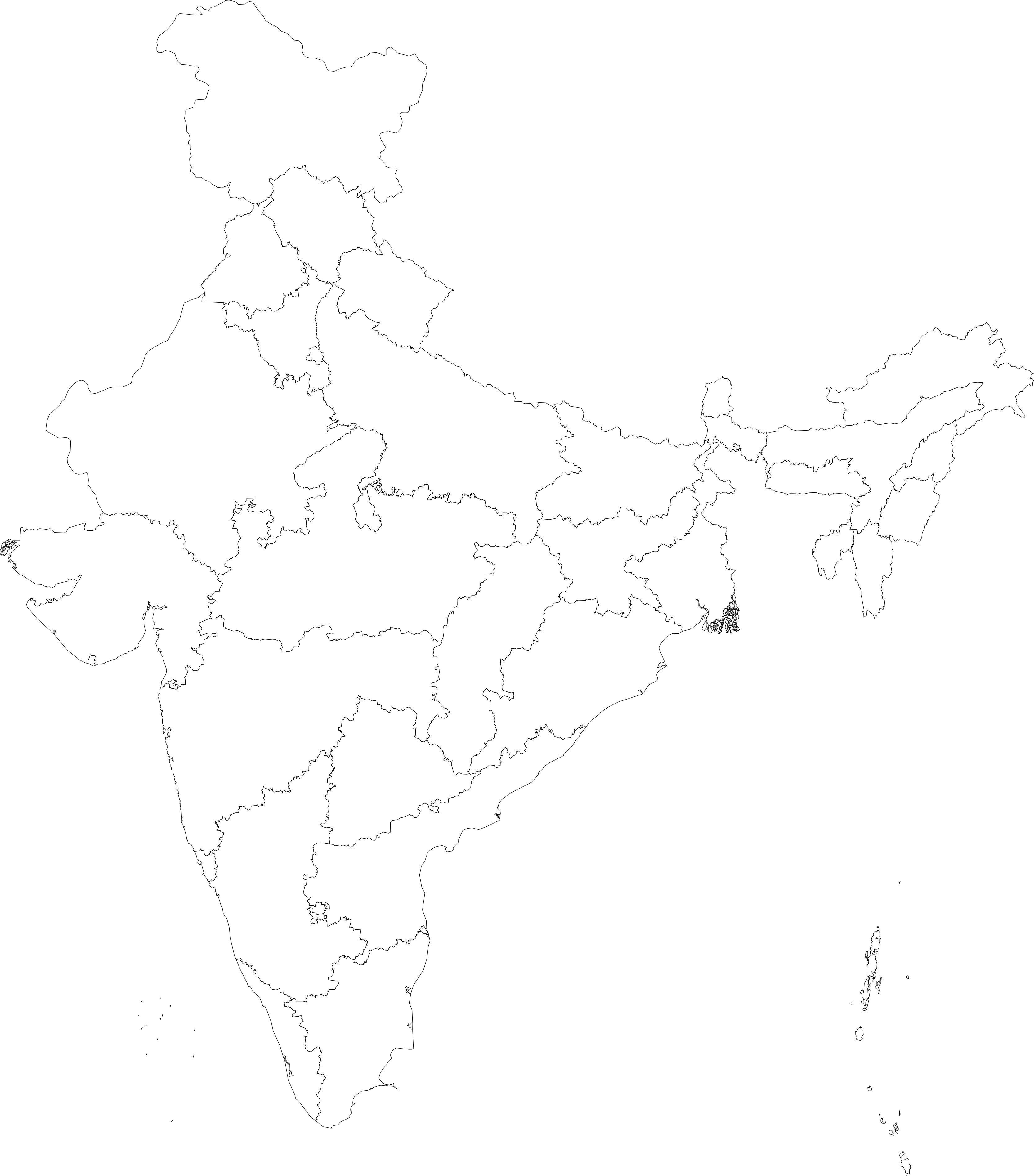
We’ve identified consulate-specific patterns across India based on which profiles get approved or rejected. This helps pinpoint exactly where your application needs to be stronger.
28%
Rejections in New Delhi
Top 4 Rejection Reasons in New Delhi Consulate
approval chances
if corrected
Immigrant Intent (214b)
48%
+65%
Approval chances if corrected
+65%
Weak Ties to India
25%
+62%
Approval chances if corrected
+62%
Financial Proof
18%
+60%
Approval chances if corrected
+60%
Others
9%
+50%
Approval chances if corrected
+50%
Recognized Patterns in New Delhi Consulate
Bank statements
6 months minimum required
Document with most weight
Employment / business proof
Lower sensitivity to
Prior travel history
Rejection Reasons Decoded
Your rejection letter often lists vague reasons for refusal. We’ve translated them so you know exactly what to fix before reapplying.
Consulate Reason
Decoded
Ideally Re-apply in
Financial Thresholds
Your trip must be financially backed, with enough margin to cover your stay comfortably. Consulates evaluate this as a trip-to-finances ratio. Use this calculator to see what your finances should look like.
enter trip details
Accommodation Type
Number of Days
Ideal Financial Strength to Meet Approval Threshold
See how similar applications performed
filter to view profiles
Profile Thresholds
Consulates evaluate applications based on financial strength, travel history, and profile stability. This tool estimates your chances of approval based on similar applicant profiles.
0%
Approval rate
for similar profiles
enter profile details
Marital Status?
Gender
First time visiting United States?
Your age
Countries Visited in the Past
Assets Owned in India
Income Range
Economic Signals
Visa decisions are also influenced by broader economic signals — like overstay rates, currency strength, and return likelihood. These factors help embassies assess overall risk from applicants.

India Travelers Who Overstay Their Visa
This percentage is below global average. Positive signal for your application.
1.2%
Below global average


Foreign Exchange Impact
A weaker rupee means your savings show lower value in the destination currency, which can affect visa thresholds
$1→ ₹96.38
1% in 90 days

How Likely Applicants Are to Return to India
Embassies assess "will this person return home?" India's economic growth and job market signal a higher likelihood of applicants returning home.
Strong
Top 5 economies
Geopolitical Signals that work for and against you
India currently
Feb
2026
Feb 2026
Trade tariff frictions and pharma sector tensions weighed on overall sentiment, though defense and tech ties (iCET, semiconductors) preserved a strategic floor.
mixed signals
Sep
2025
Sep 2025
A USD 100,000 H-1B fee proposal jolted Indian IT and pharma services; even partial implementation reshaped petitioner behavior and on-site staffing models.
approvals (work)
Apr
2025
Apr 2025
Stepped-up SEVIS terminations and student-visa revocations created chilling effect on F-1 applicants, with Indian students reporting heightened consular scrutiny.
scrutiny (student)
Jan
2025
Jan 2025
The new administration revived restrictive H-1B rhetoric and tightened specialty-occupation interpretation, raising RFE and denial rates for Indian IT services firms.
rejections (H-1B)
Jun
2024
Jun 2024
US embassies in India cleared a record visa volume, slashing B1/B2 wait times from years to weeks, signaling structural improvement in throughput.
approvals (visitor)
Frequently Asked Questions

Reapplication & Timeline
Can I reapply for a US B1/B2 visa after rejection?
Yes. There is no mandatory waiting period after a US visa rejection. However, the US State Department expects reapplications only when something has materially changed in your profile or circumstances since the previous refusal. Reapplying with the same documents and the same answers will almost certainly result in the same outcome — the consular officer sees your prior refusal on record and specifically assesses whether anything has changed.
What you need to know:
The B1/B2 refusal rate for Indian applicants was approximately 16.32% in FY2024 — significantly below the global B1/B2 average of approximately 28%, but still meaningful in absolute numbers given India's application volume
Most B1/B2 rejections cite Section 214(b) — the presumption of immigrant intent — which is the most common and most fixable refusal code
The consular officer typically makes a decision within the first 30 to 60 seconds of a 60 to 120-second interview, based on your DS-160, profile, and opening answers
A strong reapplication directly addresses the prior refusal with new and credible evidence and a tighter interview narrative
For 214(b) cases, recovery typically requires 4 to 8 weeks of profile-building; for blocking grounds (overstay, misrepresentation, criminal record), specialist legal review is required first
Atlys decodes your refusal, identifies the specific weakness, rebuilds your profile, and prepares you for the next interview through DS-160 review and mock interview tools. Apply for your US visa interview through Atlys
Related reading: US B1/B2 visa rejection reasons for Indians — Section 214(b) explained
How long should I wait before reapplying for a US visa?
The wait depends entirely on what caused your refusal. Reapplying without genuine material change in your profile is the most common reason for second-time refusals — the State Department expects reapplications to reflect a changed profile, not an attempt to find a more lenient officer.
DS-160 errors or inconsistencies corrected before submission — 1 to 2 weeks once the form is reviewed and corrected
Document gaps (missing employer letter, incomplete financial proof) — 2 to 4 weeks to build a complete document set
214(b) weak ties or insufficient funds — typically 4 to 8 weeks to build a materially stronger profile through documented changes (new employment, marriage, family responsibilities, property purchase, larger investments)
Travel purpose or interview inconsistency issues — 2 to 4 weeks for preparation and mock interview training
Building travel credibility — 3 to 6 months may help if you can complete short trips to Schengen, UK, or Southeast Asian destinations and return on time before reapplying
221(g) administrative processing — not a refusal; respond to the document request completely and within the timeframe specified
Blocking grounds (overstay, misrepresentation, criminal record) — do not reapply on a time-based schedule; specialist legal review and possible waiver required
Atlys also helps with interview appointment booking through automated slot scanning — checking for new and cancelled slots every minute across all five US consulates in India (Delhi, Mumbai, Chennai, Hyderabad, Kolkata) to get appointments in under 45 days.
Processing context: US visa rejection reasons in 2026 and expert tips
Can I appeal a US visa rejection?
No. US consular visa decisions are generally not subject to appeal by the applicant. This is established under the doctrine of consular non-reviewability — federal courts have consistently held that consular officers' visa decisions are not reviewable in US courts.
Your practical options:
Statutory appeal — not available for B1/B2 refusals
Supervisory review at the consulate — possible if you believe the officer made a procedural error (failed to consider a document you submitted, for example), but rarely granted in practice
Direct congressional inquiry — for cases with clear procedural concerns, US-based hosts can sometimes request congressional liaison through their representatives, but this is not a standard recovery path for tourism applicants
New, stronger application — the practical path for 99% of B1/B2 refusals
For blocking grounds — Section 212(a)(6)(C) misrepresentation, Section 212(a)(9)(B) overstay bars, or criminal inadmissibility — formal waiver applications (I-601 / I-212) are required before any reapplication can succeed. These are specialist legal processes that Atlys routes to qualified US immigration attorneys.
How many times can I reapply for a US visa after rejection?
There is no official cap on US visa reapplications. However, the State Department takes a progressively more critical view of repeated reapplications that show no material change in profile. Each refusal becomes cumulative evidence of weak qualifications.
Key facts about multiple rejections:
Each application incurs the non-refundable MRV fee of USD 185 (approximately INR 15,500)
Refusal records are permanent and visible globally — every future US consular officer, anywhere in the world, sees your complete refusal history
Multiple 214(b) refusals without profile change create a presumption of weak qualification that becomes progressively harder to overcome
Consulate-shopping (applying at a different US consulate without profile change) does not work — refusals are visible system-wide regardless of which consulate you apply to
After a second refusal, a professional review is essential before attempting a third application. Atlys handles multi-rejection US recovery as a specialist case — auditing both prior DS-160 submissions, identifying the unchanged weakness across attempts, and building a recovery strategy with comprehensive ties-to-India documentation and interview preparation.
Should I declare my previous US visa rejection in my new application?
Yes, absolutely. The DS-160 application form asks directly whether you have ever been refused a US visa. You must answer honestly.
Why honest disclosure is non-negotiable:
The US consulate already has your refusal on record — concealing it is futile
Concealing a prior refusal is misrepresentation under Section 212(a)(6)(C) of the Immigration and Nationality Act — a ground for permanent inadmissibility
A 212(a)(6)(C) finding requires filing an I-601 waiver to overcome, which is a complex legal process with no guarantee of success
For document-level or 214(b) rejections that were corrected, honest disclosure paired with the corrected application is standard procedure and viewed neutrally by consular officers
Officers are accustomed to reviewing reapplications and specifically look for evidence of meaningful change since the prior refusal
Acknowledging the prior refusal and demonstrating what has changed since then is a far stronger position than appearing to hide it. Atlys structures the disclosure as part of a comprehensive recovery strategy — strengthening the ties-to-India file, preparing the interview narrative, and ensuring DS-160 consistency.
Rejection Reasons & Fixes
What are the most common reasons for US B1/B2 visa rejection for Indian applicants?
Based on Atlys case data spanning 2M+ applications processed across 150+ destinations, and aligned with State Department patterns for Indian applicants, the highest-frequency US B1/B2 rejection reasons are:
Section 214(b) failure — inability to overcome the presumption of immigrant intent (the dominant rejection code, accounting for the vast majority of B1/B2 refusals)
Weak ties to India — short employment tenure, no property, no dependents, limited financial commitments
Insufficient or implausible funds — bank balance doesn't credibly cover the trip, or recent large deposits look like "show money"
DS-160 errors and inconsistencies — wrong dates, mismatched information, vague entries
Interview inconsistencies — verbal answers contradicting the DS-160 or supporting documents
Vague or unclear travel purpose — "I want to see America" without specifics, no itinerary, no concrete plan
Pattern of long stays elsewhere — frequent or extended stays in countries that suggest migration intent
221(g) administrative processing — not a refusal but a hold for additional documents or background checks
Misrepresentation under 212(a)(6)(C) — fraudulent documents or concealment (permanent inadmissibility)
Prior overstay under 212(a)(9)(B) — 3-year or 10-year bars depending on overstay length
Criminal grounds under 212(a)(2) — convictions affecting admissibility
Section 214(b) is the most common and most fixable refusal — a materially stronger ties-to-India profile, better financial documentation, and a clearer travel purpose statement can overcome it. 212(a)(6)(C), 212(a)(9)(B), and 212(a)(2) are blocking grounds requiring specialist legal handling.
Deep dive: 12 US visa rejection reasons in 2026 with expert tips
What is Section 214(b) and why does it cause so many US visa rejections?
Section 214(b) of the US Immigration and Nationality Act states that every applicant for a non-immigrant visa is presumed to be an intending immigrant unless they can prove otherwise. The burden of proof is entirely on the applicant — you must convince the consular officer that you have strong enough ties to India to ensure you will return after your trip.
What the officer is really asking:
"If I give this person a 10-year B1/B2 visa, what stops them from disappearing into the US?"
Why 214(b) dominates Indian B1/B2 rejections:
214(b) is the catch-all refusal code for any case where the officer is not affirmatively convinced of non-immigrant intent
The decision is highly discretionary — there is no specific document checklist that guarantees overcoming the presumption
The interview is 60 to 120 seconds, with most decisions made in the first 30 seconds based on the DS-160 and opening answers
The officer must affirmatively be convinced, not just have no specific reason to doubt — the default is refusal
The fix:
Building a successful 214(b) rebuttal requires multi-layered evidence covering employment, finances, family, and property simultaneously — not just one strong tie. The reapplication strategy is:
Materially stronger ties-to-India profile — comprehensive documentation across employment, property, family, business interests, and financial commitments
Better financial documentation — 6 months of organic bank activity, ITRs, salary slips, investment statements
Clearer travel purpose — specific itinerary, concrete plan, consistent with your profile
Tighter interview narrative — answers that align with the DS-160 and supporting documents
Travel history building — completed trips to Schengen, UK, or other comparable destinations demonstrating respect for visa rules
Atlys's recovery for 214(b) cases includes profile audit, document rebuild, DS-160 review, and mock interview preparation.
What counts as strong ties to India for a US visa?
Strong ties to India are the core of any US B1/B2 application — they are the evidence base for overcoming the Section 214(b) presumption of immigrant intent. Vague or undocumented claims of ties do not satisfy the consular officer.
What qualifies as a strong tie:
Current employment — employer letter on letterhead with position, salary, tenure, approved leave dates, and return-to-work confirmation; last 6 months' payslips; appointment letter
Self-employment / business ownership — business registration (GST/VAT), latest ITRs, invoices and matching bank credits, partnership deed
Property ownership in India — sale deed, property registration, encumbrance certificate
Fixed deposits and investments — FD certificates, mutual fund statements, demat holdings, insurance policies
Dependent family members in India — spouse, children, elderly parents who rely on your presence (marriage certificate, birth certificates, parents' medical or dependency proof)
Active business interests — registered business, GST registration, partnership deed
Financial or contractual obligations — running EMIs, business contracts, ongoing professional commitments
Ongoing education — for student applicants, current enrolment proof
Critical principle:
Each tie must be documented specifically and currently. The officer needs to see multiple, concrete, current ties — not generic claims. For first-time applicants under 30 without property or dependents, the strongest counter-evidence is typically stable employment with significant tenure, dependent parents, and strong financial documentation.
Atlys audits your ties profile against 214(b) standards and identifies where reinforcement is needed before any reapplication.
What financial documents do US consulates expect for a B1/B2 visa?
US consulates assess your financial standing to confirm you can fund your trip independently and that you have a stable economic base in India. The consulate looks for consistency, credibility, and proportionality — not just a single balance threshold.
Required financial documents:
6 months of bank statements — showing consistent organic activity (salary credits, regular expenses, maintained balance), preferably stamped by the bank
ITR filings — last 2 to 3 years, consistent with bank statement activity
Salary slips — last 3 to 6 months for salaried applicants
Form 16 — most recent financial year
Investment statements — FDs, mutual funds, demat holdings, insurance policies
Property valuation documents — if relevant
Business documents — for self-employed applicants
Benchmark accessible funds:
A commonly referenced benchmark is having accessible funds of approximately USD 5,000 to USD 10,000 (around INR 4 to 8 lakh) for a standard tourism trip, though the consulate assesses the overall financial picture rather than a single number. For longer trips, family visits, or business travel, increase the buffer accordingly.
Red flag patterns (Atlys's US case data):
Sudden large deposits made close to the application date — interpreted as "show money" arranged for the visa rather than genuine funds
Income doesn't match bank credits — payslips showing one figure while bank statements show another
Balance inconsistent with declared occupation — disproportionate to declared salary
Funds borrowed shortly before application — without source documentation, treated as insufficient
Limited transaction history — accounts with very few transactions suggest the bank account isn't your primary financial record
Atlys reviews your full financial profile against US assessment standards and rebuilds the financial evidence stack with appropriate justification.
What is 221(g) Administrative Processing and what should I do?
A 221(g) notice means your visa has not been refused but has been placed under administrative processing — the consulate needs additional time, documents, or clearance before a decision can be made. It is not a rejection.
Common 221(g) triggers:
Request for additional supporting documents — employment records, business documents, invitation letters, tax filings
Security or background checks — for sensitive employment fields, certain national security checks
Technology Alert List (TAL) clearance — for applicants working in specific scientific or technical fields
Verification of submitted documents — direct verification with employers, educational institutions, or businesses
Technical or processing issues — system flags requiring manual review
What 221(g) means in practice:
You do not need to reapply or pay the MRV fee again
You must respond completely to the consulate's request within the specified timeframe
Failing to respond, or responding partially, will result in the application being refused
Processing timelines for 221(g) cases vary widely — from days for simple document requests to months for security clearances
The fix:
Read the 221(g) letter carefully — identify exactly what's being requested
Compile every requested document completely
Submit through the channel specified in the letter (typically the consulate's designated email or submission portal)
Track the case status through the CEAC website using your DS-160 application number
Atlys monitors 221(g) cases actively and helps compile and submit complete responses within the consulate's timeframe.
My visa was refused for interview inconsistency. What went wrong?
Consular officers are trained to compare your interview answers in real time against your DS-160 form and submitted documents. Inconsistencies — even minor ones — raise a credibility flag and frequently trigger 214(b) refusals.
Common interview inconsistencies:
Different travel duration stated in the interview than on the DS-160
Job title described differently in conversation versus on the form
Inability to confirm specific details about your company, role, or daily work
Different contact details given verbally and on paper
Mismatched dates — when you'll travel, when you'll return, when your leave was approved
Vague or evasive answers to direct questions about your trip purpose, hosts, or itinerary
Different stated financial situation than what your documents show
Conflicting information about family — number of dependents, where they live, what they do
Why this matters:
Decisions are often made within the first 30 seconds based on your profile, DS-160, and opening answers. The officer is scanning for consistency between what you wrote and what you say. Any contradiction raises a credibility flag that's nearly impossible to recover from in a 60 to 120-second interview.
The fix:
Thoroughly review your DS-160 before the interview — know every answer you wrote
Practice your answers out loud — every key answer (trip purpose, employer, return date, ties to India) should be ready in 1 to 2 sentences
Don't memorise scripts — answer naturally and factually, but consistently
Cross-check documents for date and detail consistency before submission
Mock interview practice — Atlys's free US Mock Interview tool covers common 214(b) questions
Atlys conducts a pre-interview preparation session to help you align your narrative across your DS-160, documents, and expected interview answers.
I have a prior US overstay. Can I still apply for a new visa?
A prior US overstay is one of the most serious immigration issues for a B1/B2 reapplication. Depending on how long the overstay was, you may be subject to bars under Section 212(a)(9)(B) of the Immigration and Nationality Act:
The 9B bars:
Overstay of 180 days to 1 year — 3-year bar from re-entry once you depart the US
Overstay of more than 1 year — 10-year bar from re-entry once you depart the US
Overstay of less than 180 days — no automatic bar, but treated as serious adverse history affecting future applications
Critical points:
The bars are triggered by departure from the US after the overstay — applicants who overstayed and then left have started the bar period; applicants still in the US have not technically triggered the bar
You must declare the overstay honestly on your DS-160 — applying without declaring it is misrepresentation under 212(a)(6)(C), a permanent inadmissibility ground that's far worse than the overstay itself
A waiver of inadmissibility (I-601) may be available in limited cases, but requires demonstrating extreme hardship to a qualifying US citizen or LPR relative
Short overstays under 180 days can sometimes be overcome with strong evidence of subsequent compliance and improved profile
The right approach:
Specialist legal review before any reapplication — the case requires assessing whether a bar applies, whether a waiver is available, and the strongest framing
Full disclosure in any reapplication — concealment makes a recoverable case unrecoverable
Wait out the bar period if applicable — no reapplication during a 3-year or 10-year bar will succeed
Strong rehabilitation evidence — clean travel history since the overstay, stable life in India, demonstrated compliance with all other visa rules
Atlys routes prior overstay cases to qualified US immigration attorneys.
What does a 212(a)(6)(C) refusal mean?
Section 212(a)(6)(C) means the consular officer found that you wilfully misrepresented a material fact or submitted a fraudulent document in your application or during your interview. This is a permanent inadmissibility ground — the most serious adverse finding short of criminal grounds.
What triggers a 212(a)(6)(C) finding:
Submitting altered or fraudulent documents — fake bank statements, fake employer letters, fabricated invitation letters
Concealing a prior visa refusal from any country
Concealing a prior overstay in the US or elsewhere
Misrepresenting employment, income, or family circumstances
Using a fake invitation letter or fabricating a host relationship
Lying during the interview in response to a direct question
Consequences:
Permanent inadmissibility to the United States
Visible globally — every future visa officer sees the finding
Cannot be resolved by waiting or reapplying — only by formal waiver
Cross-destination impact — declared on all future UK, Schengen, Canada, Australia, New Zealand applications and treated as serious adverse history
Recovery options:
I-601 Waiver of Inadmissibility — possible in limited cases, requires demonstrating extreme hardship to a qualifying US citizen or LPR spouse, parent, or child
No standard reapplication will succeed during the inadmissibility — every future B1/B2 application will be refused under the same ground
The right approach:
This is a blocking case requiring specialist legal handling. Atlys routes 212(a)(6)(C) cases to qualified US immigration attorneys with experience in waiver applications.
What is the difference between a B1 and B2 visa, and does it affect my application?
The B1 and B2 are distinct non-immigrant visa categories with different permitted activities. Most Indian applications are filed for a combined B1/B2 visa, which covers both purposes.
B1 (Business Visitor):
Permitted activities: attending business meetings, conferences, conventions, negotiating contracts, consulting with business associates, training programs (no productive employment), settling estate matters
NOT permitted: working in the US, receiving US-source income, productive employment
Stay duration: typically up to 6 months per visit
B2 (Tourist Visitor):
Permitted activities: tourism, vacation, visiting family or friends, medical treatment, social events, amateur participation in events (no compensation), short recreational courses under 18 hours per week
NOT permitted: working, studying for academic credit, productive employment
Stay duration: typically up to 6 months per visit
Combined B1/B2:
Covers both business and tourism purposes
The default category for most Indian applicants
Issued for 10 years validity for Indian passport holders (with 6-month stays per entry)
Why category mismatch causes refusals:
Applying for B2 (tourist) when your actual purpose is business — attending meetings as a "tourist" is a refusal trigger and potentially misrepresentation
Applying for B1 (business) when your purpose is tourism — the consulate views this as inconsistent with your profile
Stated B2 purpose but really intending to work — productive employment on a B2 is a serious violation
The fix:
Make sure your DS-160 accurately reflects the primary purpose of your trip. Your documents and interview answers must be consistent with that stated purpose. For mixed-purpose trips (business meetings plus some tourism), apply for B1/B2 combined — and clearly explain both purposes in your application.
Renewal context: How to renew a US B1/B2 visa from India without rejection
Documents & Application Requirements
What documents should I bring to a US B1/B2 visa interview?
The consular officer may not look at all your documents, but having them ready demonstrates preparedness and supports your verbal answers.
Mandatory documents (non-negotiable):
Current passport — valid for at least 6 months beyond intended stay
All old passports — to demonstrate international travel history
DS-160 confirmation page — printed and signed
Appointment confirmation — interview appointment letter
MRV fee receipt — visa application fee payment proof
Photograph — meeting US visa photo specifications (2×2 inches, white background, taken within 6 months)
Financial documents:
6 months of bank statements — original or bank-stamped, showing consistent organic activity
ITR filings — last 2 to 3 years
Salary slips — last 3 to 6 months (salaried applicants)
Form 16 — most recent financial year
Investment statements — FDs, mutual funds, demat holdings
Employment proof:
Employer letter on letterhead — designation, salary, approved leave, return-to-work confirmation, authorised signatory's details
Appointment letter — original or attested copy
Last 3-6 months' payslips
Ties to India:
Property documents — sale deeds, property registrations
Fixed deposit certificates
Dependent family proof — marriage certificate, children's birth certificates, parents' dependency proof
Travel documents:
Flight itinerary — confirmed or tentative (refundable bookings recommended until visa is approved)
Hotel bookings — confirmed for full stay
Day-wise itinerary — specific cities, dates, planned activities
Purpose-specific documents:
For business visits — invitation letter from US company, conference registration, business purpose explanation
For family visits — host's US status documents (passport, green card, or visa copy), invitation letter, relationship proof
For self-employed applicants, replace employer letter with:
Company registration certificate
GST filings
Recent ITR
Bank statement in the company's name showing active business transactions
Complete checklist: Documents required for US B1/B2 visa interview from India
How should I prepare for the US visa interview?
The US visa interview is typically 60 to 120 seconds — the shortest interview of any major destination — and is the most important part of the application. Most decisions are made in the first 30 seconds based on your DS-160, profile, and opening answers.
The officer typically asks 3 to 5 questions, focused on:
Purpose of your trip — be specific in 1 to 2 sentences
What you'll do in the US — itinerary, activities, places
When you'll come back — clear return date
What keeps you in India — ties (employment, family, property)
Your work — designation, employer, daily responsibilities
Who's hosting you (if visiting family/friends) — name, address, relationship, their status
Preparation framework:
Know your DS-160 cold — the officer may ask about any field; every answer must match what you wrote
Prepare 1 to 2 sentence answers for the core questions above — clear, factual, confident
Don't memorise scripts — answer naturally and factually, but consistently
Practice out loud — say your answers in a normal conversational tone before the interview
Bring documents organised by category (financial, employment, ties, travel) for quick reference
Dress professionally and arrive early — first impressions form within the first 5 seconds
Stay calm and concise — answer the question asked, don't volunteer extra information
Be honest — every answer must be truthful; concealment is misrepresentation under 212(a)(6)(C)
The classic 3-question test:
"Why are you going, when are you coming back, and what keeps you in India?"
Every applicant should be able to answer these three questions confidently and consistently within the first 30 seconds of the interview.
Mock interview preparation:
Atlys offers a free US Mock Interview tool that simulates real consular interview scenarios and provides feedback on your answers. Use it multiple times before your actual interview.
DS-160 guide: How to fill the DS-160 form for B1/B2 visa
How does Atlys help recover a US visa after rejection?
Atlys handles US rejection recovery as a structured, multi-step process designed around the specific failure point in your previous application:
Step 1 — Diagnostic review. We decode your rejection code (214(b), 221(g), 212(a)(6)(C), 212(a)(9)(B), 212(a)(2)), assess the depth of the issue, and map it to specific gaps in your previous DS-160, document set, and interview narrative.
Step 2 — Profile assessment. We evaluate your current profile against US consulate standards — ties to India, financial depth, travel history, and immigration record — and determine whether reapplication is achievable on your current profile or whether 4 to 8 weeks of profile-building is required first.
Step 3 — Personalised recovery plan:
214(b) weak ties cases: Comprehensive ties-to-India evidence pack rebuilt — employment confirmation with return-to-work, property documents, financial profile strengthening, dependent family documentation
214(b) financial cases: Bank statement quality strengthened, ITR consistency verified, fund-source justifications prepared
DS-160 errors and inconsistencies: Full form review, every field cross-checked against passport and supporting documents
Interview inconsistency cases: Mock interview preparation through Atlys's US Mock Interview tool, narrative alignment across DS-160, documents, and verbal answers
Travel purpose cases: Detailed itinerary built, host invitation letters (where applicable), cover letter that ties purpose to profile
221(g) administrative processing: Complete document response compiled and submitted within the consulate's timeframe
Blocking grounds (212(a)(6)(C), 212(a)(9)(B), 212(a)(2)): Routed to qualified US immigration attorneys for waiver preparation
Step 4 — Appointment booking and interview preparation. Atlys's automated slot scanning checks for new and cancelled appointment slots every minute across all five US consulates in India (Delhi, Mumbai, Chennai, Hyderabad, Kolkata) — getting B1/B2 appointments in under 45 days, compared to standard wait times of 2 to 10 weeks per consulate. DS-160 review, document preparation, and mock interview practice happen in parallel with appointment booking.
Recovery timelines:
DS-160 corrections: 1 to 2 weeks
Document gaps: 2 to 4 weeks
214(b) profile rebuild: 4 to 8 weeks
Travel purpose / interview prep: 2 to 4 weeks
Interview appointment booking: Under 45 days through Atlys (versus 2 to 10 weeks standard wait)
221(g) cases: Timeline depends on consulate response; document submission within days
Blocking grounds: Specific timeline provided after specialist legal review
Why Atlys handles US recovery effectively:
Automated appointment slot scanning every minute across all five US consulates in India
Pan-India coverage — Delhi, Mumbai, Chennai, Hyderabad, Kolkata — not just one or two cities
Free US Mock Interview tool simulating real consular interview scenarios
DS-160 review and simplification — Atlys's interface simplifies a 6+ hour government form into quick guided questions
Disclosure-first reviews — every previous refusal, overstay, and adverse history item correctly disclosed
~99.2% delivery prediction accuracy backed by 2M+ applications processed across 150+ destinations
~90% faster processing than traditional channels on supported categories
Money-back protection on supported categories
Exclusive MakeMyTrip flight partnership for refundable flight bookings
On-ground presence in India, UAE, Great Britain, Vietnam, and Philippines
Talk to an expert
Not sure if you should reapply? Get a free reapplication strategy.
Rejection Recovery
If your application is rejected again, we refund every rupee - no questions asked.
Government Fee
₹18,200
Mandatory fee set by USA
Atlys Fee
₹26,532
Approval Guarantee Fee (incl. 18% GST)
Total Amount
₹44,732
Atlys Protect
If your application is rejected again, we refund every rupee