Rejection Recovery
If your application is rejected again, we refund every rupee - no questions asked.
Government Fee
₹4,780
Mandatory fee set by South Korea
Atlys Fee
₹8,573
Approval Guarantee Fee (incl. 18% GST)
Total Amount
₹13,353
Atlys Protect
If your application is rejected again, we refund every rupee
Talk to an expert
Not sure if you should reapply? Get a free reapplication strategy.
 Data sourced from over 24,000+ Atlys applications
Consulate Specific Data
We’ve identified consulate-specific patterns across India based on which profiles get approved or rejected. This helps pinpoint exactly where your application needs to be stronger.
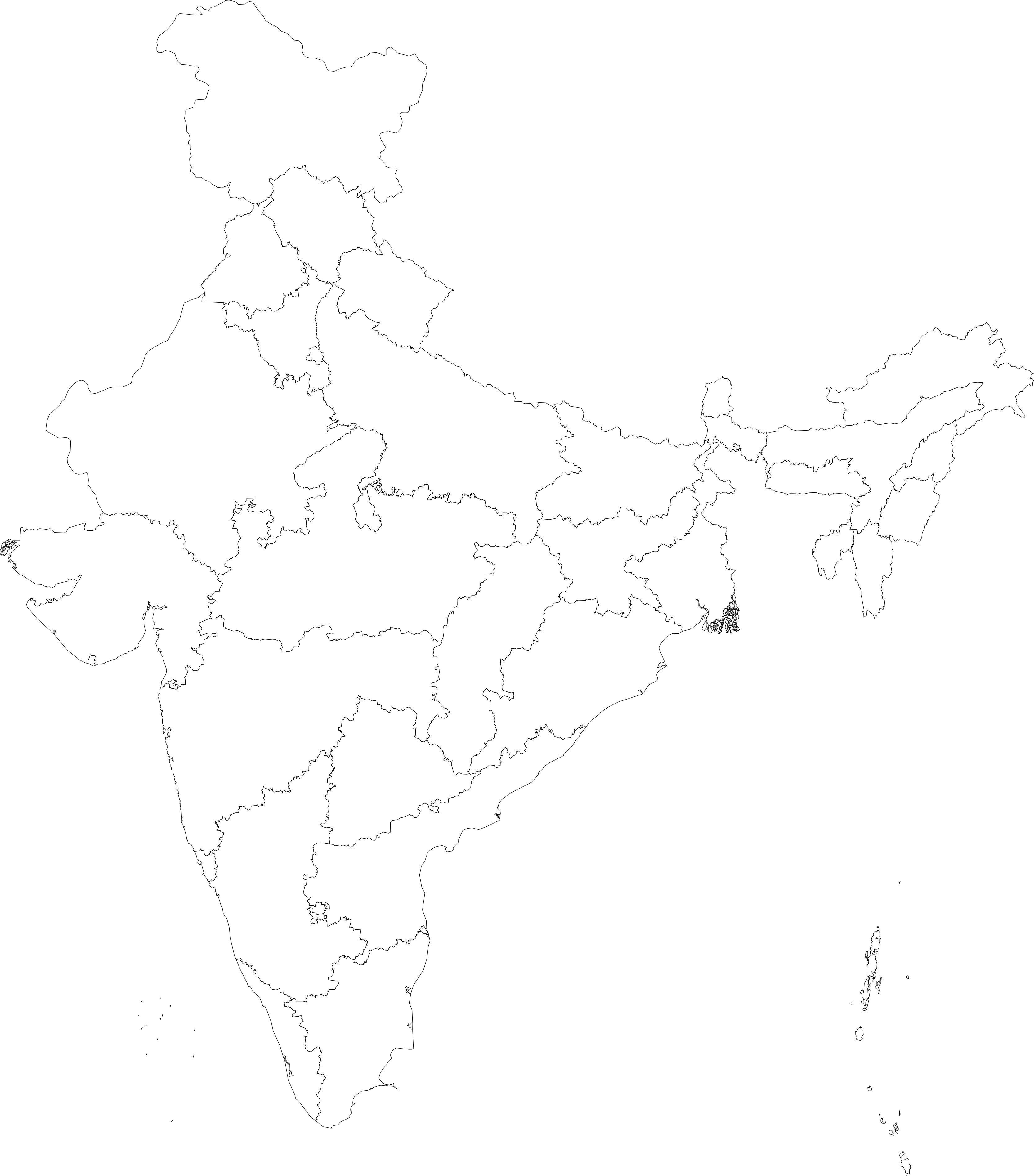
9%
Rejections in Mumbai
Top 3 Rejection Reasons in Mumbai Consulate
approval chances
if corrected
Delayed Documents (Bank Statement / NOC)
45%
+80%
Approval chances if corrected
+80%
Financial Proof
35%
+74%
Approval chances if corrected
+74%
Others
20%
+58%
Approval chances if corrected
+58%
Recognized Patterns in Mumbai Consulate
Bank statements
3 months — must be current at submission date
Document with most weight
Bank statement + employer NOC (hard copy)
Lower sensitivity to
Prior travel history to Korea
Rejection Reasons Decoded
Your rejection letter often lists vague reasons for refusal. We’ve translated them so you know exactly what to fix before reapplying.
Consulate Reason
Decoded
Ideally Re-apply in
See how similar applications performed
filter to view profiles
Profile Thresholds
Consulates evaluate applications based on financial strength, travel history, and profile stability. This tool estimates your chances of approval based on similar applicant profiles.
0%
Approval rate
for similar profiles
enter profile details
Marital Status?
Gender
First time visiting South Korea?
Your age
Countries Visited in the Past
Assets Owned in India
Income Range
Economic Signals
Visa decisions are also influenced by broader economic signals — like overstay rates, currency strength, and return likelihood. These factors help embassies assess overall risk from applicants.

India Travelers Who Overstay Their Visa
This percentage is below global average. Positive signal for your application.
1.2%
Below global average


Foreign Exchange Impact
A weaker rupee means your savings show lower value in the destination currency, which can affect visa thresholds
KRW 1→ ₹0.072
15% in 90 days

How Likely Applicants Are to Return to India
Embassies assess "will this person return home?" India's economic growth and job market signal a higher likelihood of applicants returning home.
Strong
Top 5 economies
Geopolitical Signals that work for and against you
India currently
Mar
2026
Mar 2026
Korea launched a Top-Tier visa for global talent with India among targeted source markets, boosting prospects for STEM PhDs and AI researchers.
approvals (talent)
Nov
2025
Nov 2025
Hyundai, Samsung, and LG announced expanded India operations, prompting Seoul to fast-track intra-company transfer visas for senior Indian engineers and managers.
ICT visa flow
Apr
2025
Apr 2025
Domestic political turbulence following the brief martial-law episode slowed embassy throughput, lengthening visa processing times for Indian applicants.
delays
Sep
2024
Sep 2024
Korea's E-7 specialist visa quota expanded with India listed as a priority sourcing country for IT, shipbuilding, and chip-design talent.
approvals (work)
May
2024
May 2024
Seoul and New Delhi expanded the Special Strategic Partnership with new defense and semiconductor cooperation tracks, opening pathways for skilled-worker mobility.
skilled-worker access
Frequently Asked Questions

Reapplication & Timeline
Can I reapply for a South Korea visa after rejection?
Yes. The Korean Consulate does not impose a mandatory waiting period after a visa refusal. However, reapplying without addressing the specific reason for the rejection will produce the same outcome. Korean visa applications require honest declaration of prior refusals, and the Consulate has visibility of your application history through its central records.
What you need to know:
South Korea is uniquely strict among major Asian destinations because the Consulate makes direct outbound phone verification calls to applicants as part of the review process — preparing for this call is as important as preparing the documents themselves
The Korean Consulate updated standard processing time to 18 to 25 working days as of April 2026, significantly longer than the previous standard
A strong reapplication must address both the document gaps and (where applicable) the phone verification preparation
For document-level rejections (expired bank statement, delayed NOC), recovery is targeted and fast; for verification call failures, recovery requires application rebuild plus call preparation
Atlys diagnoses the exact rejection cause, rebuilds the application file, and provides a detailed pre-call preparation brief covering every question the Consulate is known to ask for your profile type. Apply for your South Korea visa through Atlys
How long should I wait before reapplying for a South Korea visa?
The wait depends entirely on what caused your rejection. Reapplying too quickly without genuine correction produces the same outcome, while reapplying after targeted fixes can succeed quickly.
Expired bank statement or delayed hard copy documents (the most common KR rejection trigger) — 1 to 3 days once the fresh document is obtained
Incomplete application — 1 to 2 weeks for full document sourcing and verification
Financial proof issues — 2 to 4 weeks to build organic bank activity and consistent ITR alignment
Phone verification failure — 2 to 4 weeks to strengthen the application and prepare detailed verification responses
Prior overstays or immigration violations — do not reapply on a time-based schedule; specialist review required first
Standard Korean Consulate processing after submission is 18 to 25 working days (as of April 2026). Additional delays occur during Korean national holidays — Seollal (January or February), Chuseok (September or October), Liberation Day (15 August), and the early October National Foundation holidays. Atlys provides a specific recovery timeline after diagnosing your case.
Processing context: South Korea visa processing time and what affects it
Can I appeal a South Korea visa rejection?
The Korean Consulate does not offer a formal public appeals process for tourist or short-stay visa refusals. There is no tribunal or administrative review mechanism for standard visa categories.
Your practical options:
Formal appeal — not available
Direct consulate enquiry — possible for clarification, rarely changes outcomes
Corrected reapplication — the standard recovery path for 95%+ of refusals
Korean visa refusal letters do not always state a detailed specific reason — if no reason was given, Atlys diagnoses the most likely cause based on your application file, the phone verification call outcome, and the known rejection patterns for your specific profile.
A well-prepared reapplication covering every known risk factor — document completeness, hard copy validity, phone verification readiness, and financial profile strength — is the most effective recovery path.
How many times can I reapply for a South Korea visa after rejection?
There is no official cap on Korean visa reapplications, but repeated rejections without fixing the underlying issue increase Consulate scrutiny and — critically — make successive phone verification calls progressively harder to pass convincingly.
Key facts about multiple rejections:
Each reapplication incurs the Korean visa processing fee
The Korean Consulate maintains records across all submission centres in India — switching cities does not bypass the prior refusal history
Repeated refusals on the same profile signal that the underlying issue has not been resolved
For applicants who failed the phone verification call once, the Consulate may apply heightened scrutiny on subsequent calls
If you have been refused twice, Atlys conducts a comprehensive audit of both prior applications and phone verification outcomes before recommending the timing and approach for resubmission.
Should I declare my previous South Korea visa rejection in my new application?
Yes. The Korean visa application form asks whether you have previously been refused a visa to South Korea or any other country. You must answer honestly.
Why honest disclosure matters:
The Korean Consulate already has your prior application on record
Concealing a prior refusal is treated as misrepresentation, which is significantly more serious than the original rejection
For document-level rejections that were corrected, honest disclosure paired with the corrected application is standard procedure
For phone verification rejections, the disclosure must be paired with a rebuilt application narrative that prepares you for follow-up questions on the call
Acknowledging the prior refusal and demonstrating what has been corrected is the correct approach. Atlys structures the disclosure as part of a rebuilt cover letter and prepares you for verification call questions about the prior refusal.
Rejection Reasons & Fixes
What are the most common reasons for South Korea visa rejection or delay for Indian applicants?
Based on Atlys case data spanning 2M+ applications processed across 150+ destinations, the highest-frequency South Korea rejection and delay reasons for Indian applicants are:
Delayed hard copy documents — bank statement and employer NOC not provided within the required submission window
Expired bank statement at the point of submission (older than 1 month from physical submission date)
Consulate phone verification call where the response was unsatisfactory — unique to the Korean Consulate
Insufficient financial proof — low balance, inconsistent ITR, sudden large deposits
Incomplete documents at submission
Photograph or photo specification issues
Consulate processing delays during peak seasons and post-April 2026 timeline extension
Active valid Korea visa already on passport — duplicate application
Inconsistencies between application form and supporting documents
Prior overstay or immigration violation
The phone verification call is unique to the Korean Consulate and is the most unpredictable rejection trigger. The hard copy document validity window is the most operationally common issue — applications get caught between document preparation and submission scheduling.
What is the Korean Consulate's phone verification call and how should I prepare for it?
The Korean Consulate for India makes direct outbound phone calls to visa applicants as part of the review process. This is unique among major Asian destinations and is one of the most common rejection triggers for applicants who are otherwise well-documented.
How the call works:
The call is typically made to the mobile number on your application form
Calls happen during business hours (Indian time)
The officer will ask questions about your trip purpose, employer, travel dates, accommodation, and reasons for visiting Korea
The call may be conducted in English or Hindi depending on the officer
Why applicants fail the call:
Not answering the call — applications are refused if the Consulate cannot reach you
Inconsistent answers — stating a different salary than the employer NOC, or different hotel names than the booking
Vague responses — unable to confidently confirm itinerary details, hotel cities, or specific reasons for the trip
Contradicting documents — answers that don't match the cover letter, application form, or supporting documents
Preparation checklist:
Know your hotel bookings cold — names, cities, check-in and check-out dates, the order of cities
Memorise your itinerary — what you're doing each day, which cities, key attractions
Confirm your employer details — full company name, address, your designation, leave dates approved
Know your salary figure — the exact amount stated in your NOC
Prepare your "why Korea" — a specific, credible reason (K-drama tourism, K-pop, food, history, business — whatever applies)
Keep your application form accessible — the officer may ask you to confirm specific details from it
Answer the call from a quiet location — background noise or distractions can be flagged
Atlys provides a pre-call preparation brief for every Korean visa applicant covering the questions the Consulate is most likely to ask based on your profile.
My Korea visa was rejected after the Consulate called me. What should I do?
A phone verification rejection is recoverable but requires structured preparation for the reapplication.
Step 1 — Review what happened on the call:
Try to recall the specific questions asked and the answers you gave. Common failure patterns in Atlys's Korea case data:
Applicant could not confirm hotel names or city order
Stated a different salary figure than the employer NOC
Gave a vague reason for visiting Korea ("just for tourism") when the application specified a detailed K-drama itinerary
Could not name specific attractions or locations from the stated itinerary
Was contacted in a noisy environment and could not hear questions clearly
Step 2 — Rebuild the application for consistency:
Tighten the itinerary so every detail can be confirmed verbally
Match every figure across documents (salary, dates, addresses)
Simplify where possible — a clear, specific itinerary is easier to remember than an elaborate one
Step 3 — Prepare for the next verification call:
For the reapplication, Atlys rebuilds a more specific, internally consistent application file and provides a detailed pre-call brief covering every question the Consulate is likely to ask based on your profile. The brief covers itinerary details, employer details, financial details, and common follow-up questions.
Why did my bank statement get flagged as expired or invalid?
The Korean Consulate requires bank statements that are current as of the submission date — statements older than 1 month from the physical submission date are treated as expired.
Why this is a common rejection trigger:
Bank statements are typically prepared 1 to 2 weeks before the application is filed
If there is a delay in courier collection of hard copies, appointment scheduling, or document submission, the statement can age past the 1-month validity window
The Consulate does not consider this a "minor issue" — an expired statement is treated as a missing document
Hard copy requirement:
The bank statement must be an original hard copy on official bank letterhead with bank stamp — internet banking printouts are generally not accepted unless stamped by the bank.
The fix for reapplication:
Request a fresh bank statement dated as close to the planned submission date as possible
Ensure the statement covers the last 3 months of activity
Verify the statement is on official bank letterhead with bank stamp
Submit through Atlys so the statement validity is tracked against the actual submission date
Atlys tracks bank statement dates proactively and requests a fresh statement if the one on file is at risk of expiring before submission, eliminating this rejection cause.
What financial documents does the Korean Consulate expect for a tourist visa?
The Korean Consulate assesses your financial profile to confirm you can fund your trip independently. The Consulate scrutinises consistency carefully and requires hard copy original documents for the key financial items.
Required financial documents:
3 months of bank statements — original hard copies on official bank letterhead, stamped, current within 1 month of submission date, showing consistent organic activity (salary credits, regular expenses, maintained balance)
ITR filings — last 1 to 2 years (3 years strengthens the application)
Salary slips — last 3 months for salaried applicants
Form 16 — most recent financial year
Investment statements — FDs, mutual funds, demat holdings (if relevant)
Benchmark accessible funds:
For a standard 7 to 10-day Korea trip, accessible funds of approximately USD 1,450 to USD 1,800 (roughly INR 1,20,000 to INR 1,50,000) are recommended. For trips longer than 2 weeks, increase to USD 2,100 to USD 2,400. The Consulate assesses the full financial picture rather than a single threshold.
Daily budget context:
Seoul and Busan: USD 60 to USD 90 per day
Jeju Island: slightly higher due to limited local transport and accommodation costs
Red flag pattern:
Statements with sudden large deposits, inactive accounts, or balances inconsistent with declared income raise immediate questions. The Consulate looks for financial consistency and credibility, not just a balance threshold. If you have a recent large deposit, prepare a written explanation with source documentation.
In-depth guide: Minimum bank balance for a South Korea visa
What are the hard copy document requirements for a South Korea visa?
South Korea visa applications require original hard copy documents for the key financial and employment items — not printouts or digital scans. This is one of the operationally most common reasons for delayed or rejected applications.
Hard copy requirements:
Bank statements — original, on official bank letterhead, stamped by the bank (internet banking printouts are generally not accepted unless stamped)
Employer NOC — original on company letterhead with an original signature (not a scanned copy)
Application form — physically signed
Original passport — must be couriered to Atlys for physical submission to the Korean Consulate
Photocopies of supporting documents — required where specified, but originals accompany the application for the key items
Why hard copies matter:
The Korean Consulate verifies document authenticity through physical examination. Stamped, signed originals are difficult to forge, which is why the Consulate insists on them for the most critical documents. Scanned or photocopied versions of bank statements and NOCs are typically rejected as insufficient.
Atlys verifies hard copy specifications before submission and tracks the validity window so documents don't expire between preparation and filing.
What is the current South Korea visa processing time from India?
As of April 2026, the Korean Consulate has updated standard processing time to 18 to 25 working days from the date of submission. This is a significant extension from the previous standard and reflects increased application volumes from India.
Factors that extend processing further:
Seollal (Korean Lunar New Year — January or February)
Chuseok (harvest festival — September or October)
Liberation Day (15 August)
Korean National Foundation holidays in early October
Peak Indian travel seasons for Korea — March to May (cherry blossom) and September to November (autumn foliage)
Phone verification call scheduling — can add days to the timeline
The practical rule:
If your travel is time-sensitive, plan to submit your application at least 5 to 6 weeks before your intended travel date. During peak seasons or near Korean holidays, allow 6 to 8 weeks end-to-end.
Atlys tracks processing timelines proactively and flags applications approaching their travel window, with priority handling for time-sensitive cases.
What is the difference between a single-entry and multiple-entry Korea visa?
South Korea issues different visa types based on entry frequency, and applying for a type for which you don't yet qualify can be a rejection trigger.
Visa types by entry frequency:
Single-entry visa — allows one entry into South Korea during the validity period (typically 3 months from issue); most common for first-time applicants
Multiple-entry visa — allows unlimited entries within validity (typically 1, 3, or 5 years); available to applicants with demonstrated history of clean Korea travel
For first-time Korean visa applicants from India:
The Consulate typically issues a single-entry visa. Multiple-entry visas are generally available to applicants who have:
Visited Korea at least once on a single-entry visa
Departed on time without overstay
Built a clean travel history with Korea or comparable destinations
Demonstrated repeat travel need (frequent business, family connections, established travel pattern)
If you are a first-time applicant, do not specifically apply for a multiple-entry visa — this can be a rejection trigger because the Consulate views the application as inconsistent with your travel history. Atlys applies for the entry type appropriate to your profile.
Does South Korea require a sponsor letter for a tourist visa?
A sponsor letter is not required for a standard self-funded tourist visa application. However, sponsor documentation is required when someone else is funding your trip.
When a sponsor letter is required:
Korean national or resident sponsoring your accommodation or expenses — sponsor letter from them plus their Korean resident registration certificate or passport copy
Group travel where one person funds the trip — clear financial responsibility letter from the funding person, supported by their bank statements
Family-funded trip — letter from the funding family member with relationship proof and their bank statements
For solo applicants funding their own trip:
The sponsor letter section is simply left blank — strong personal financial documentation (bank statements, ITR, salary slips) is sufficient.
For business visa applicants:
An invitation letter from the Korean host company is required, detailing the nature of business, duration of stay, and the relationship between the parties.
Atlys advises on whether sponsor documentation is needed based on your specific application profile and funding source.
Documents & Application Requirements
What documents are required for a South Korea tourist visa for Indian nationals?
Core document set for a South Korea short-term tourist visa:
Passport (original) — valid for at least 6 months beyond return date, with at least one blank page; copies of all old passports if applicable; original must be couriered to Atlys for physical submission
Photograph — 35mm × 45mm, plain white background, taken within 6 months
Application form — Korean visa application form, completed and physically signed
Employer NOC (original hard copy) — on company letterhead with original signature, confirming employment, approved leave dates, salary, return-to-work confirmation
Bank statements (original hard copy) — last 3 months, on official bank letterhead, stamped, current within 1 month of submission date
ITR / Form 16 — last 1 to 2 years (3 years strengthens the application)
Salary slips — last 3 months (salaried applicants)
Confirmed return flight tickets — showing entry into and exit from South Korea
Hotel bookings — confirmed accommodation for every night of the stay
Day-wise itinerary — specific cities, dates, and planned activities in South Korea
Cover letter — directly addressing prior refusal (in reapplications) and what has changed
For self-employed applicants, replace NOC with:
Company registration certificate
GST filings (last 3 to 6 months)
Recent ITR (last 2 years)
Original business bank statements
For students, add:
Bonafide certificate from institution
Sponsor's financial documents and ITR
Sponsor's relationship proof
The critical step for reapplications: fix the specific weakness that caused the previous rejection — most commonly an expired bank statement, a missing NOC element, or an inconsistency that triggered a phone verification failure.
Application context: South Korea visa requirements for Indiansz
Why must I courier my original passport for a South Korea visa?
The Korean Consulate issues the visa as a physical sticker that is affixed directly onto your passport — it cannot be issued digitally. The Consulate requires the original passport to be physically submitted as part of the application.
How the process works through Atlys:
You complete your application on Atlys
You courier your original passport and hard copy documents to the nearest Atlys processing centre (available across Mumbai, Chennai, Bangalore, Delhi, and Kolkata)
Atlys reviews and prepares your complete application file
Atlys physically submits your passport and documents to the Korean Consulate via the authorised submission channel
Your passport remains with the Korean Consulate during processing (18 to 25 working days as of April 2026)
Atlys couriers your passport back to you with the visa sticker once approved
Important — plan your travel accordingly:
During the 18 to 25 working day processing window, your passport will be with the Korean Consulate. Ensure you do not have any other travel commitments requiring your passport during this period. Other visa applications, international travel, or passport-required activities must be scheduled around the Korea application timeline.
No in-person visits required:
You do not need to visit the Korean Consulate or submission centre in person at any point. Atlys handles all physical submission and collection on your behalf.
Tracking guide: How to track your South Korea visa application status
How does Atlys help recover a South Korea visa after rejection or delay?
Atlys handles South Korea rejection recovery as a structured process designed around the Korean Consulate's specific requirements — hard copy validity, phone verification preparation, and the extended 18 to 25 day processing timeline:
Step 1 — Diagnostic review. We audit your prior application file, identify whether the issue was document-related (expired bank statement, delayed NOC, incomplete file), verification-related (phone call response), or systemic (financial proof, immigration violation).
Step 2 — Document and verification assessment. For document cases, we identify the specific gap and source the corrected document. For verification failures, we review what answers were given on the call and identify inconsistencies with submitted documents.
Step 3 — Personalised recovery plan:
Expired bank statement cases: Fresh statement requested immediately, resubmitted within 1 to 3 days of receiving the current document
Delayed hard copy document cases: Direct follow-up with you on outstanding documents, exact specifications confirmed, expedited submission once documents are in hand
Phone verification failure cases: Application rebuilt with more specific itinerary and clearer employment narrative; detailed pre-call preparation brief covering every question the Consulate is likely to ask based on your profile type
Incomplete document recovery: Full checklist audit against Korean Consulate requirements; every item sourced and verified before resubmission within 1 to 2 weeks
Financial proof rebuild: 2 to 4 weeks of bank statement strengthening, ITR alignment, and fund-source justification with supporting evidence
Active visa duplicate cases: Status verification and guidance on when reapplication is appropriate
Embassy delay cases: Proactive monitoring with status updates and decision alerts
Step 4 — End-to-end submission and passport return. Atlys handles physical passport submission to the Korean Consulate via the authorised submission channel and couriers your passport back with the visa sticker once approved. Standard processing is 18 to 25 working days from submission.
Recovery timelines:
Expired or delayed document cases: 1 to 3 days for resubmission, plus 18 to 25 working days for Consulate processing
Incomplete document cases: 1 to 2 weeks for preparation, plus standard processing
Financial proof cases: 2 to 4 weeks of profile-building
Phone verification failure cases: 2 to 4 weeks for application rebuild and preparation brief
Why Atlys handles South Korea recovery effectively:
Submission centres across Mumbai, Chennai, Bangalore, Delhi, and Kolkata
Pre-call preparation brief unique to Atlys — covers every question the Consulate is known to ask based on your profile
Hard copy validity tracking — fresh documents requested before expiration
~99.2% delivery prediction accuracy backed by 2M+ applications processed across 150+ destinations
~90% faster processing than traditional channels
Money-back protection on supported categories
Exclusive MakeMyTrip flight partnership for confirmed flight bookings meeting Consulate requirements
On-ground presence in India, UAE, Great Britain, Vietnam, and Philippines
Talk to an expert
Not sure if you should reapply? Get a free reapplication strategy.
Rejection Recovery
If your application is rejected again, we refund every rupee - no questions asked.
Government Fee
₹4,780
Mandatory fee set by South Korea
Atlys Fee
₹8,573
Approval Guarantee Fee (incl. 18% GST)
Total Amount
₹13,353
Atlys Protect
If your application is rejected again, we refund every rupee